In a discovery that fundamentally alters our understanding of biological limits, an international team of scientists has unveiled the existence of a vast, thriving ecosystem nearly six miles beneath the surface of the Pacific Ocean. Utilizing the Chinese manned submersible Fendouzhe, researchers from the Institute of Deep-sea Science and Engineering (IDSSE) at the Chinese Academy of Sciences identified a sprawling network of life within the Hadal trenches—the deepest regions of the ocean floor.
This discovery represents the deepest chemosynthesis-based community ever documented. Far from the desolate, barren landscape once imagined by early explorers, these deep-sea valleys host a vibrant, complex community of thousands of mollusks, tubeworms, and crustaceans, challenging long-held scientific models regarding carbon cycling and the resilience of life in extreme, high-pressure environments.
The Chronology of an Extraordinary Expedition
The journey to uncover these hidden worlds began with a systematic campaign of exploration in the western Pacific. Throughout the previous year, the Fendouzhe submersible conducted 23 separate dives into the Mariana Trench—a crescent-shaped abyss that plunges deeper than the summit of Mount Everest is tall.
The expedition focused on the Kuril-Kamchatka Trench and the western Aleutian Trench, seeking to understand whether these "hadal" zones—areas deeper than 6,000 meters—could sustain complex life. While earlier studies had confirmed the presence of single-celled organisms and minimal life forms in such depths, the Fendouzhe team uncovered something entirely different: a biological "oasis."
Following the initial sightings, researchers deployed high-definition camera systems and robotic samplers to catalog the biodiversity. The subsequent analysis of these findings, published in the journal Nature, confirmed that these life forms were not merely surviving in isolation but were part of a vast, interconnected community spanning over 1,500 miles at depths ranging from 3.6 to nearly 6 miles below sea level.
Supporting Data: A World Built on Chemicals
The fundamental mystery of this ecosystem is how it survives without the sun. At these depths, no solar light can penetrate the crushing water column. Photosynthesis, the process that powers nearly all surface life, is impossible. Instead, these organisms rely entirely on chemosynthesis.
The study, led by Xiatong Peng and co-authored by marine geochemist Mengran Du, provides evidence that the community is fueled by hydrogen sulfide and methane-rich fluids. These chemicals are transported along geological faults that traverse the deep sediment layers of the trenches. Isotopic analysis conducted by the team suggests that this methane is produced microbially from organic matter deposited on the seafloor, creating a foundation for a complex food web.
Biodiversity in the Dark
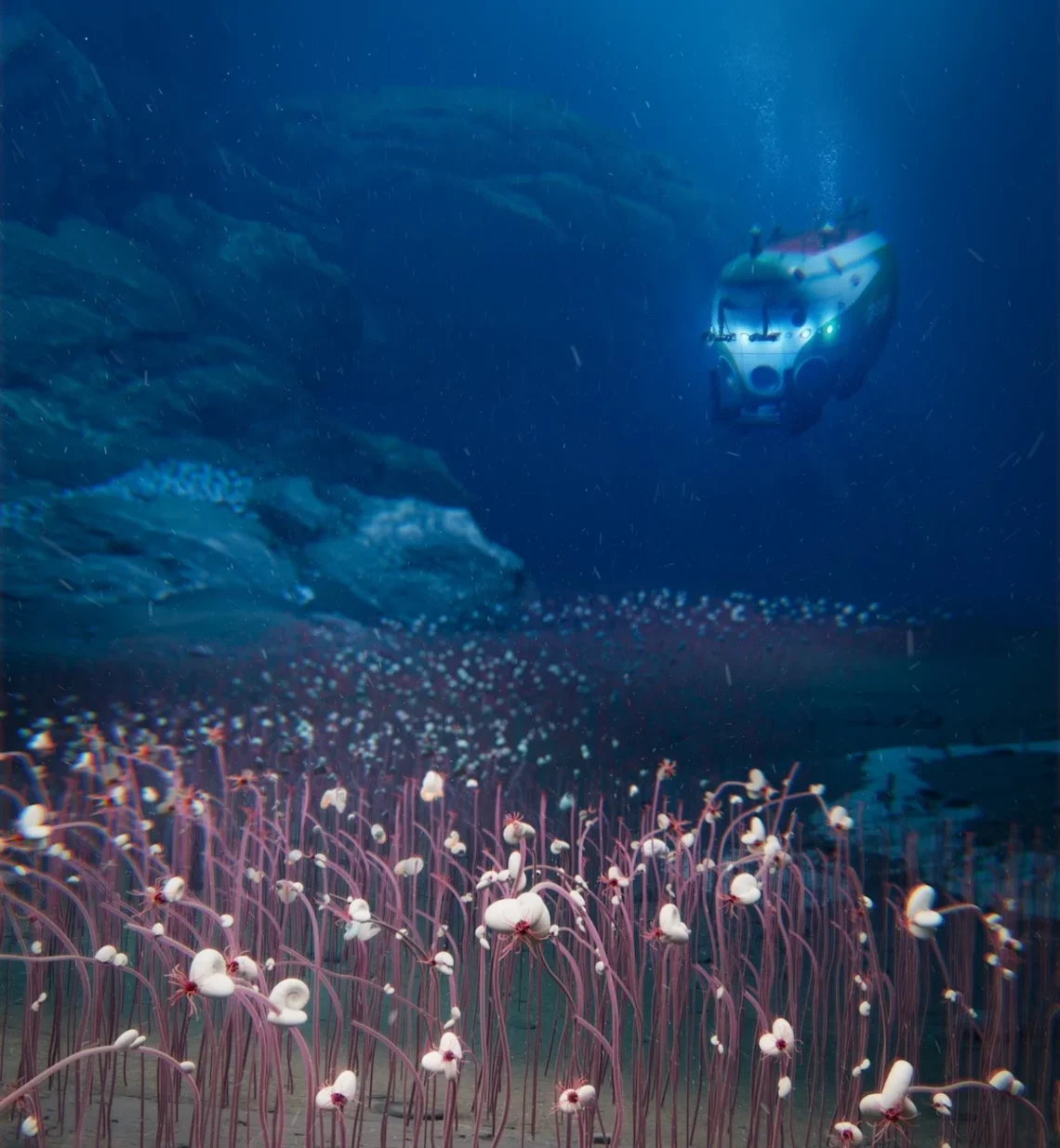
The visual data captured by the Fendouzhe reveals an alien landscape that is surprisingly lush:
- Tubeworms: Species reaching up to a foot in length, observed clustering around microbial mats.
- Mollusks and Bivalves: Vast colonies of clams found in concentrated mounds, indicating a high-density population.
- Mobile Invertebrates: The team recorded free-floating marine worms, spiky crustaceans, sea lilies, and sea cucumbers.
"What makes our discovery groundbreaking is not just its greater depth," said Mengran Du. "It is the astonishing abundance and diversity of chemosynthetic life we observed. Unlike isolated pockets of organisms, this community thrives like a vibrant oasis in the vast desert of the deep sea."
Implications for Science and Future Exploration
The findings published in Nature carry significant weight for several scientific disciplines, most notably marine biology and geochemistry. By proving that life can flourish at such extreme depths, scientists are now forced to re-evaluate the current models of deep-ocean carbon cycling. If these trenches are more biologically active than previously estimated, it implies that the Earth’s deep-sea carbon sequestration capacity may be far more dynamic than current climate models account for.

Furthermore, the geological similarities between the discovered sites and other unexplored hadal trenches worldwide suggest that these communities are likely widespread. This discovery shifts the paradigm of the ocean from a "deep, dark void" to a potential frontier of biodiversity that remains largely unmapped.
For the researchers, the experience of descending into the trench was described as "traveling through time." Each dive offered a glimpse into a primordial realm, stripping away the familiar comforts of the surface world to reveal a hidden, pulsating architecture of life.
The Ethical Dilemma: Conservation vs. Extraction
This discovery comes at a pivotal moment in international policy. As the scientific community celebrates this breakthrough, the global conversation remains deadlocked over the issue of deep-sea mining.
Proponents of the mining industry argue that the seafloor contains critical minerals necessary for the transition to renewable energy—specifically for the production of electric vehicle batteries. However, marine biologists and environmental advocates warn that the very ecosystems now being discovered are among the most fragile on the planet. Because these organisms exist in a delicate chemical balance, any industrial disruption, such as the dredging of sediments or the release of mining waste, could cause irreversible damage to these habitats before we even fully understand them.
The International Seabed Authority (ISA) has been tasked with creating a regulatory framework for deep-sea mining, yet the process remains stalled by scientific concern. The Fendouzhe discovery provides a strong, empirical argument for the "precautionary principle." If such extensive, complex life exists in places once deemed "desolate," the potential for unintended destruction during mining operations is significantly higher than earlier impact assessments suggested.
Conclusion: A Final Frontier
The work of the Institute of Deep-sea Science and Engineering serves as a stark reminder of how little we know about our own planet. Hollywood director James Cameron, who famously piloted a solo descent to the bottom of the Mariana Trench in 2012, characterized the experience as an encounter with an "alien" world. Yet, the work of Peng, Du, and their colleagues suggests that this world is not as alien as it is interconnected.
As we look toward the future, the integration of advanced robotics and manned submersibles like the Fendouzhe will be essential. The discovery of these chemosynthetic oases is likely only the beginning. There are dozens of other trenches across the globe that have never been explored with this level of precision.
The "vibrant oasis" found in the Mariana Trench proves that life is not merely a surface phenomenon. It is a resilient force that permeates the deepest reaches of the Earth’s crust, finding ways to turn chemical waste into life. Protecting these hidden ecosystems is no longer just an environmental concern; it is a scientific imperative to preserve the secrets of life’s origins and its capacity to endure against the most extreme pressures on the planet.
As the international community continues its debate over the deep sea, the images of tubeworms swaying in the dark, fed by the earth’s own chemistry, provide a powerful visual testament to the wonders that remain waiting in the abyss—provided we do not destroy them before we have the chance to fully know them.