Main Facts: The Reality Behind Cancer Drug Marketing
Modern medicine has achieved astonishing feats, yet few areas of healthcare are wrapped in as much linguistic ambiguity and commercial spin as oncology. When a newly approved cancer medication enters the market, it is frequently heralded by pharmaceutical manufacturers, medical journals, and mainstream media outlets as a "game changer" or a "breakthrough." However, a rigorous look at the empirical data reveals a starkly different reality.
When aggregated, the overall survival benefit provided by new chemotherapy drugs approved over a twelve-year window averages a remarkably modest 2.1 months. Despite this, these therapies often command astronomical prices—sometimes approaching $170,000 annually—frequently failing to improve overall survival while severely degrading the patient’s quality of life. Furthermore, many treatments that fail to demonstrate clinically meaningful benefits in postmarket evaluations retain their FDA approval, remaining on the market at exorbitant costs.
This disconnect between statistical significance and tangible patient benefit raises critical ethical questions about informed consent, pharmaceutical marketing, and the true cost of modern cancer care.
Chronology: From Clinical Trial Design to Postmarket Realities
To understand how marginal medical benefits are translated into blockbuster commercial successes, one must examine the timeline of how cancer therapies are developed, evaluated, and marketed.
- Pre-Approval Phase (Trial Design): Pharmaceutical companies design large-scale clinical trials that focus on statistical endpoints rather than practical, life-altering outcomes. By comparing combination therapies against single-agent baselines or placebos, researchers look for statistically significant variances.
- The Approval Milestone: Regulatory bodies, such as the U.S. Food and Drug Administration (FDA), grant approval based on these controlled clinical trials. Often, approval is granted under accelerated pathways relying on surrogate markers—such as tumor shrinkage—rather than proven extensions of overall survival or quality of life.
- Commercial Launch and Marketing: Newly approved drugs enter the market carrying six-figure price tags and optimistic descriptors in medical literature, framing toxic side effects with terms like "manageable," "acceptable," or "feasible."
- Postmarket Evaluation: Subsequent independent studies often reveal that the drugs offer negligible survival advantages over traditional baselines or placebos, sometimes even worsening patient outcomes.
- The Status Quo (Market Retention): Despite postmarket data confirming a lack of clinical efficacy, the vast majority of these drugs retain their FDA approval and high price points, remaining accessible and heavily prescribed.
Supporting Data: What the Numbers Tell Us
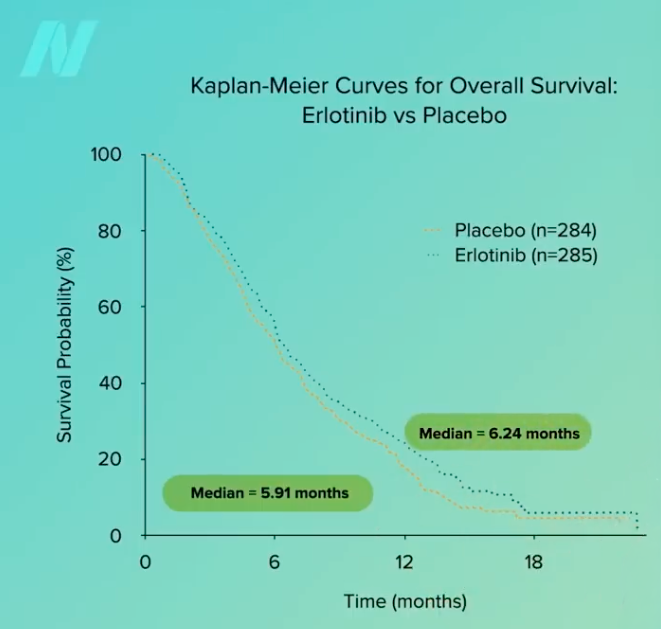
The chasm between statistical terminology and human experience is quantifiable. Consider a landmark clinical trial evaluating the addition of the drug erlotinib to gemcitabine for advanced pancreatic cancer. The study found that patients receiving the dual-therapy regimen experienced a statistically significant prolongation of overall survival compared to the control group receiving gemcitabine alone.
However, the raw numbers tell a sobering story: the placebo group survived for an average of 5.91 months, while the multi-drug group survived for 6.24 months. That translates to an extension of roughly one-third of a month—about 10 days. Patients endured heightened side effects and substantial financial burdens for an average gain of 10 days of life.

When researchers aggregate the overall survival benefits of all new chemotherapy drugs approved over a decade-long span, the mean benefit hovers at just 2.1 months. Yet, patient expectations diverge wildly from these figures. Surveys of metastatic lung and colorectal cancer patients reveal that approximately 75% do not understand that their chemotherapy is unlikely to be curative. Rather than viewing chemo as a palliative measure to eke out a few extra weeks, many harbor the mistaken belief that the treatment offers a legitimate chance of complete recovery.
When compared against historical milestones, the limitations become clearer. While chemotherapy has achieved monumental successes in specific, rarer malignancies—such as testicular cancer and Hodgkin’s lymphoma, where five-year survival rates are drastically improved—its impact on the most common adult cancers (colon, lung, breast, and prostate) yields estimated five-year survival improvements closer to 1% to 2%.
Official Responses and Linguistic Euphemisms
The communication gap between oncologists and patients is exacerbated by how clinical data is reported in top-tier medical journals and interpreted in clinical settings.
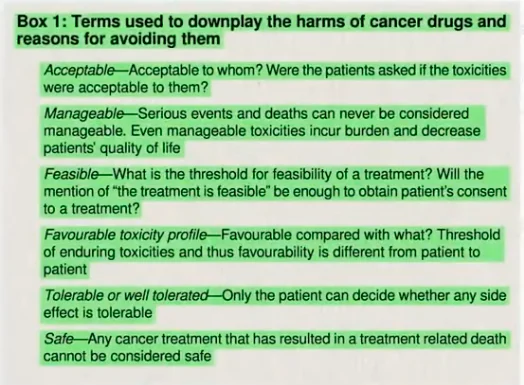
Pharmaceutical sponsors frequently employ calculated euphemisms to soften the blow of severe toxicity profiles. For instance, clinical studies have described the breast cancer drug ribociclib as possessing an "acceptable" side-effect profile, and the pancreatic cancer drug liposomal irinotecan as featuring a "manageable and mostly reversible safety profile."
Independent analyses of the underlying data, however, reveal that serious or life-threatening adverse events on these medications can be double to fivefold higher than comparative baselines. Words like "manageable" omit the reality of patients who suffer permanent organ damage or fatal toxicities. "Acceptable" begs the question: acceptable to whom—the manufacturer, the prescribing physician, or the patient facing irreversible cardiac failure, severe neuropathy, or total immune system suppression?
Because most chemotherapy drugs are inherently cytotoxic—meaning they kill rapidly dividing cells indiscriminately, attacking both malignant tumors and healthy tissues like the lining of the gut—the collateral damage is profound. It is perhaps telling that studies assessing the personal preferences of oncologists and cancer nurses consistently show they are significantly less willing to undergo intensive, high-toxicity chemotherapy regimens themselves compared to what they routinely recommend to patients.
Implications: Autonomy, Cost, and Preventive Focus
The ramifications of this systemic disconnect extend far into the realms of medical ethics, personal autonomy, and healthcare economics.
1. The Erosion of Informed Consent
When patients are not explicitly told that a palliative chemotherapy regimen offers zero chance of a cure and will yield only weeks or months of extended life at the cost of severe physical toxicity, their right to informed consent is compromised. True autonomy requires that individuals be allowed to weigh the authentic risks of a treatment against its actual benefits. Studies indicate that when explicitly asked, cancer patients typically desire at least half a year of extended life to justify enduring intensive side effects. If fully informed of marginal gains, many might choose alternative paths focusing on comfort, palliative care, and quality of life over aggressive chemical interventions.
2. Economic Sustainability
The financial toxicity of modern cancer care cannot be ignored. Pouring hundreds of thousands of dollars into treatments that fail to extend survival or improve quality of life places an unsustainable burden on healthcare systems, insurance structures, and patients’ families. Continuing to subsidize and market ineffective drugs creates a perverse economic incentive for pharmaceutical developers to prioritize minor chemical iterations over true clinical breakthroughs or preventative measures.
3. A Shift Toward Prevention
Ultimately, managing advanced cancer through expensive, marginally effective end-stage treatments addresses the crisis downstream. True progress requires a fundamental pivot toward cancer prevention. Emphasizing evidence-based dietary modifications, lifestyle interventions, and early screening protocols remains our most powerful tool in reducing the societal and personal toll of malignant disease before toxic chemotherapies ever enter the equation.