By Investigative Health Desk
For decades, the global dietary supplement market has positioned itself as an indispensable ally in the pursuit of wellness. From multivitamin complexes promising enhanced immunity to specialized botanicals marketed for weight loss and cognitive vitality, the industry has ballooned into a multi-billion-dollar juggernaut. Yet beneath the glossy packaging, clinical imagery, and wellness-influencer endorsements lies a troubling reality: the dietary supplement sector operates in a largely unregulated gray zone.
According to public health data, consumers have little to no guarantee that a supplement will actually contain what is advertised on its label, nor can they be certain the product is free from dangerous, undeclared contaminants. Coupled with pervasive marketing spin and a defensive corporate posture that occasionally targets independent researchers with retaliatory lawsuits, the supplement industry presents a complex web of consumer risk, regulatory loopholes, and scientific distortion.
Main Facts: The Anatomy of an Unregulated Market
The core vulnerability of the dietary supplement industry stems from a fundamental mismatch between the sheer volume of products on the market and the enforcement capacity of regulatory bodies. In the United States alone, the Food and Drug Administration (FDA) estimates that there are more than 85,000 distinct dietary supplement products available to consumers.
This staggering inventory creates an enforcement nightmare. Regulators are severely constrained by limited resources, the difficulty of successfully prosecuting bad actors, and the alarming ease with which unscrupulous manufacturers can rebrand and reintroduce products once they have been pulled from store shelves.
Furthermore, routine oversight is largely reactive rather than proactive. Unlike pharmaceutical drugs, which must undergo rigorous pre-market clinical trials to prove safety and efficacy, dietary supplements do not require FDA approval before hitting the market. Manufacturers are technically responsible for ensuring product safety, but compliance is heavily reliant on self-policing.
The consequences of this hands-off approach are tangible. National health data links dietary supplements to approximately 23,000 emergency room visits every year in the U.S. alone. These hospitalizations are often driven by:
- Adulteration with undeclared pharmaceuticals: Laboratory testing frequently uncovers active pharmaceutical ingredients hidden inside supplements—most commonly in products marketed for erectile dysfunction, weight loss, diabetes, and hypertension.
- Toxic contaminants and heavy metals: The presence of unlisted heavy metals, pesticides, and industrial chemicals.
- Designer stimulants: The inclusion of synthetic, amphetamine-like analogs designed to mimic legal stimulants while skirting regulatory bans.
Despite these documented hazards, consumer loyalty remains remarkably resilient. Public health studies indicate that a vast majority of supplement users would be "minimally influenced" by independent, taxpayer-funded studies that contradict manufacturer efficacy claims. Furthermore, only about a quarter of consumers report that they would stop taking a supplement if public health authorities formally declared it a waste of money.
Chronology: From Patent Medicines to Modern "Snake Oil"
The tension between commercial hype and public protection is not a modern phenomenon; it has roots stretching back more than a century.
Early 20th Century: The Rise of the Rattlesnake King
The archetype of the deceptive tonic salesman was famously embodied by Clark Stanley, infamously known as the "Rattlesnake King." Stanley toured the United States peddling his proprietary "snake oil," which he claimed possessed miraculous healing properties. However, a federal investigation in 1916 revealed a shocking truth: Stanley’s snake oil contained no snake oil at all. Instead, it was a crude mixture of mineral oil, beef fat, red pepper (capsicum), and turpentine.
Prosecuted under the newly enacted Pure Food and Drug Act of 1906—one of the earliest federal attempts to regulate consumer safety—Stanley was found guilty of misbranding and fined a paltry sum of $20.
The Late 20th and Early 21st Centuries: The Dietary Supplement Health and Education Act (DSHEA)
The modern regulatory landscape for supplements was fundamentally shaped in 1994 with the passage of the Dietary Supplement Health and Education Act (DSHEA). While intended to protect consumer access to vitamins and herbs, DSHEA created a remarkably permissive framework that shifted the burden of proof onto the FDA. Under this law, the agency must prove a supplement is unsafe after it is already on the market, rather than requiring proof of safety before commercialization.
Recent Decades: The Rise of "Spin" and Retaliatory Litigation
As the market expanded into a multi-billion-dollar global enterprise in the 2000s and 2010s, trade organizations and manufacturers evolved sophisticated public relations strategies. Independent researchers analyzing the dissemination of scientific findings discovered that industry trade groups routinely manipulated clinical data to protect commercial interests.
This era also marked an escalation in corporate pushback against academic scrutiny. When independent scientists began utilizing advanced laboratory techniques to detect dangerous designer stimulants in mainstream weight-loss products, they faced aggressive legal challenges designed to suppress scientific inquiry and intimidate the academic community.

Supporting Data: The Ubiquity of "Spin" and Market Deception
To understand why consumer enthusiasm for supplements remains high despite accumulating evidence of ineffectiveness, researchers have examined how scientific findings are translated to the public. While medical journals, pharmaceutical companies, and even top academic medical centers have historically faced criticism for overstating scientific findings in press releases, the supplement industry stands apart in its systematic distortion of data.
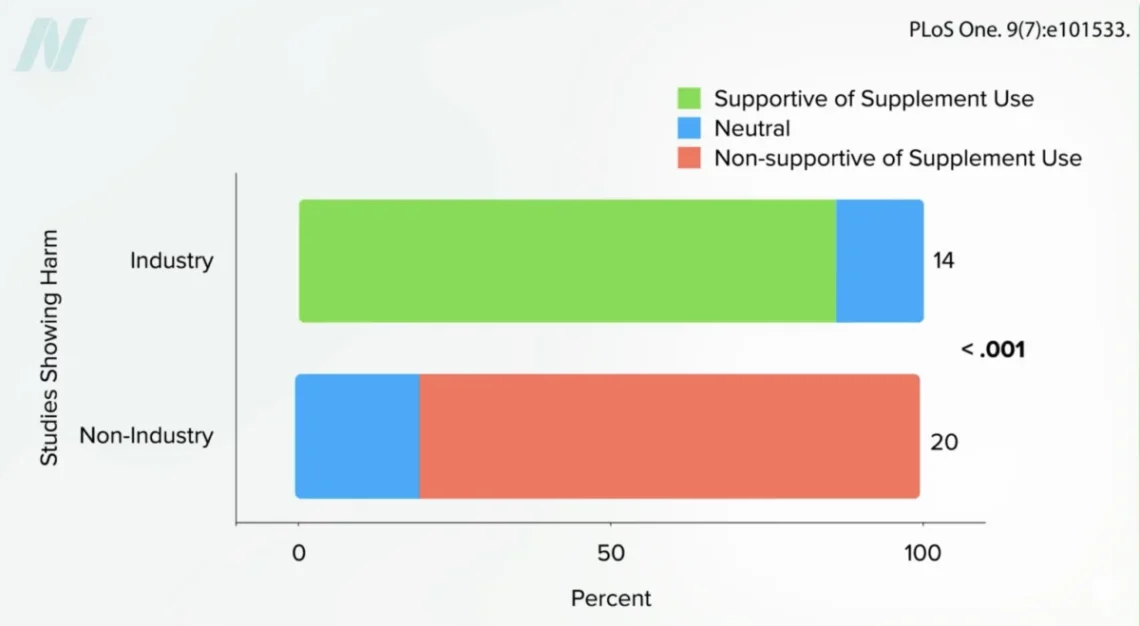
A landmark case-control study evaluating press releases issued by supplement industry trade organizations versus non-industry entities revealed staggering results: 100% of supplement industry press releases contained "spin." The researchers defined spin as specific communication strategies designed to hype, distort, or denigrate findings to alter the apparent conclusions of clinical trials.
Even more alarming is how these organizations responded to negative data:
- 90%+ Disregard for Negative Findings: Industry press releases actively advocated for supplement use in response to more than 90% of clinical studies that explicitly reported no benefit or actual harm.
- The Inverse Public Health Message: If an independent institution like the National Institutes of Health (NIH) publishes a study indicating a supplement is useless or potentially harmful, mainstream public health advisories urge avoidance. Conversely, trade organizations effectively responded with a commercial green light, downplaying risks and encouraging continued consumption.
The Problem of "Dry Labbing" and Purity Claims
To counter growing consumer skepticism regarding product purity, many manufacturers point to third-party certifications. However, the industry harbors an open secret known as "dry labbing." In this fraudulent practice, compromised quality assurance laboratories rubber-stamp fake documentation and certificates of analysis without actually testing the underlying batches of raw materials or finished products.
Official Responses and Institutional Battles
The friction between independent academia and commercial supplement manufacturers has occasionally erupted into high-stakes legal warfare. A prime example involves the investigation of $beta$-methylphenylethylamine (BMPEA), a designer, amphetamine-like stimulant discovered in various dietary supplements sold across the United States.
The Harvard Study and the Legal Retaliation
Following initial detections by the FDA, a researcher at Harvard University published a peer-reviewed paper replicating and expanding upon these findings, identifying dangerous synthetic stimulants lurking in popular weight-loss supplements such as Black Widow and Yellow Scorpion, manufactured by Hi-Tech Pharmaceuticals.
Rather than addressing the safety concerns or recalling the products, Hi-Tech Pharmaceuticals launched a fierce legal counter-offensive. The company sued the Harvard researcher for libel, slander, and product disparagement, initially seeking a staggering $200 million in damages.
In investigative reporting published by STAT—a prominent independent medical journalism outlet—the head of Hi-Tech openly admitted the primary motivation behind the lawsuit: “hoping that we were able to silence this guy.”
Although the multimillion-dollar lawsuit was ultimately unsuccessful in court, the chilling effect on the scientific community was immediate and profound. The company’s leadership explicitly noted that the long and costly legal battle was intended to serve as a warning, designed to scare other academic researchers away from investigating the chemical safety and efficacy of the dietary supplement industry.
Regulatory Limitations
Trade organizations frequently push back against media and academic criticism by insisting that the industry is heavily regulated and that existing laws adequately protect consumers. Legal scholars and public health officials acknowledge that statutes do exist on the books, but they emphasize that regulatory agencies lack the manpower, budget, and statutory authority to effectively police tens of thousands of rapidly shifting formulations.
Implications: Navigating the Modern Wellness Landscape
The systemic issues plaguing the dietary supplement industry carry profound implications for public health, medical research, and consumer protection.
- Erosion of Evidence-Based Medicine: When commercial trade groups routinely spin 100% of their communications and advocate for products proven to be harmful, they actively undermine public trust in rigorous, peer-reviewed science. This creates a parallel wellness ecosystem immune to empirical correction.
- Economic and Physical Toll: Consumers continue to spend hard-earned money on products that may offer zero therapeutic value—or worse, result in acute liver injury, cardiovascular strain, or emergency room visits due to undeclared pharmaceutical adulterants.
- The Chilling of Academic Research: Aggressive litigation, such as the strategic lawsuits against public participation (SLAPPs) deployed against academic researchers, threatens to create a "donut hole" in public health surveillance. If independent scientists fear financial ruin or lengthy defamation suits for publishing safety data, consumers are left entirely unprotected.
Moving Forward
Public health advocates argue that meaningful reform requires modernizing regulatory frameworks—potentially granting the FDA mandatory recall authority, requiring pre-market notification with safety data for new ingredients, and establishing stricter penalties for fraudulent labeling and "dry labbing."
Until structural reforms are enacted to bridge the gap between regulatory intent and real-world enforcement, the multi-billion-dollar supplement market will likely remain a modern frontier of the ancient "snake oil" trade—where marketing hype consistently supersedes medical reality, and the consumer is left to navigate a labyrinth of unverified promises.