
In contemporary health debates, a recurring critique echoes through corporate boardrooms, industry-funded white papers, and skeptical opinion columns: that the observational studies driving modern nutritional science lack real credibility. Critics, often representing massive food and pharmaceutical conglomerates, argue that because nutritional epidemiology relies heavily on population observation rather than randomized controlled trials (RCTs), public dietary guidelines are built on shaky foundations.
However, a deeper examination of the methodology, historical precedents, and financial conflicts of interest reveals a more calculated narrative. The systematic attempt to label nutrition science as "low-quality evidence" is not merely an academic disagreement over research methods; it is frequently a strategic corporate playbook designed to protect profits at the expense of public health.
Main Facts: The Clash Between Nutritional Science and Corporate Critiques
At the heart of the debate is a fundamental misunderstanding—or deliberate misapplication—of how scientific evidence is gathered and evaluated. Randomized controlled trials are widely considered the gold standard in clinical medicine, particularly for testing pharmaceutical interventions. By randomly assigning participants to receive either a drug or a placebo in a double-blind setting, researchers can isolate variables and establish direct cause-and-effect relationships.
Yet, applying this exact model to nutrition is practically impossible and scientifically inappropriate. Dietary diseases, such as cardiovascular disease and cancer, often take decades to develop. Researchers cannot realistically confine human subjects to a controlled facility for twenty years to force-feed them specific diets, nor can they create a "placebo food." People cannot easily stick to strictly assigned, randomized diets over long periods, and the ethical barriers to forcing human subjects to consume potentially harmful substances—such as heavy metals, trans fats, or excessive sugars—are insurmountable.
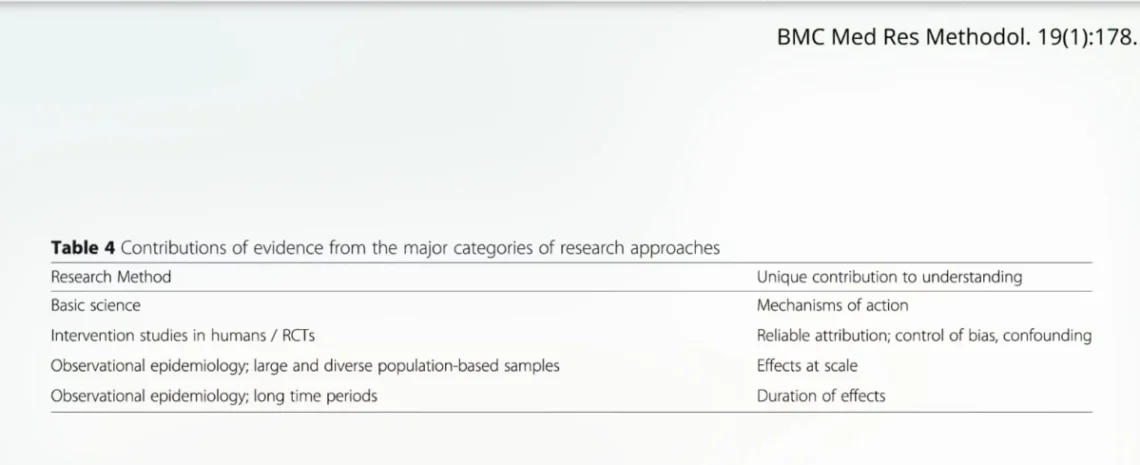
Consequently, nutrition science relies on a diverse ecosystem of research methods:
- Laboratory studies explore exact biological mechanisms at the cellular level.
- Randomized controlled trials evaluate short-term physiological markers and specific interventions.
- Massive observational cohort studies track hundreds of thousands of individuals over decades to identify correlations between dietary patterns and long-term health outcomes.
When researchers compare data obtained from large-scale observational population studies against randomized trials, the results are remarkably consistent. In approximately 90% of the treatments examined, the effects observed in epidemiological studies were not only in the same direction as clinical trials but also shared the same general magnitude.
Furthermore, historical health policies have proven that waiting for the "perfect" randomized trial on hard endpoints like mortality can be fatal. Public health officials must act on the best available balance of evidence. For instance, society does not wait for randomized trials where children are deliberately exposed to lead or PCBs to determine safe toxicity thresholds; instead, evidence is synthesized from all available sources to protect the public.
Chronology: A History of Methodological Manipulation
The friction between public health guidelines and corporate interests follows a clear historical trajectory, marked by strategic campaigns to manufacture doubt.
The Trans Fat Precedent
Decades ago, the accumulation of both short-term randomized trials (showing that trans fats raised risk factors for heart disease) and long-term observational studies (showing higher rates of heart disease among those consuming more trans fats) built an undeniable case. While scientists never conducted a randomized trial where people were forced to eat canisters of shortening for years to see who suffered fatal heart attacks, the weight of the collective evidence prompted the U.S. food supply to largely phase out artificial trans fats. This preventative action saved an estimated 200,000 heart attacks annually.
The Rise of the Drug Trial Paradigm in Nutrition
As public health authorities increasingly pointed toward dietary culprits—such as sugar and processed meats—industries fought back by adopting the pharmaceutical evaluation model, known as GRADE (Grading of Recommendations Assessment, Development and Evaluation). Originally designed to evaluate the high-certainty demands of prescription drugs, GRADE inherently penalizes observational data.
Because lifestyle and diet cannot easily be subjected to double-blind trials, applying GRADE to nutrition systematically downgrades the evidence to "low quality," regardless of how robust or consistent the epidemiological data may be.

This loophole has been exploited repeatedly:
- The Sugar Industry Strategy: A prominent paper funded by sugar industry interests concluded that dietary guidelines advising people to reduce sugar intake were untrustworthy because they relied on "low-quality evidence" evaluated through the inappropriate drug-trial paradigm. Ironically, these same papers pointed to historical inconsistencies in sugar guidelines over a 20-year period to claim the science was unstable—ignoring the fact that the most glaring outlier guideline (a 2002 Institute of Medicine report stating that a quarter of daily calories could come from added sugar) was partially funded by an institute backed by major beverage and confectionery corporations.
- The Meat Industry Playbook: Following the blueprint laid down by the sugar lobby, institutions funded by meat industry interests later hired the exact same methodology experts to evaluate red and processed meat guidelines. Predictably, using the GRADE framework, these studies concluded that current recommendations to limit meat consumption were based on low-quality evidence, providing industry stakeholders with the scientific cover needed to dismiss public health warnings.
Supporting Data: Assessing Evidence Through NutriGrade and HEALM
Recognizing the flaws in applying pharmaceutical standards to dietary research, the scientific community has developed alternative scoring systems tailored specifically to the realities of nutrition.
- NutriGrade: Unlike traditional tools, NutriGrade is a scoring system specifically designed to assess nutrition research. Crucially, it explicitly incorporates funding bias into its evaluation criteria, automatically downgrading the credibility of industry-funded trials. This built-in accountability explains why corporate-funded authors tend to avoid NutriGrade in favor of frameworks like GRADE.
- HEALM (Hierarchies of Evidence Applied to Lifestyle Medicine): Developed to address questions that cannot be fully resolved through RCTs, HEALM provides a realistic structure for weighing lifestyle, dietary, and behavioral interventions. It acknowledges that each research methodology—from lab experiments to epidemiological cohorts—contributes a vital piece to the broader public health puzzle.
The necessity of contextualizing evidence becomes starkly apparent when comparing the risks of dietary advice versus prescription drugs. Prescription medications rank as a leading cause of death in developed nations, with tens of thousands of Americans dying annually from adverse side effects even when the drugs are taken exactly as directed. Given such high stakes, society rightly demands rock-solid, double-blind, placebo-controlled trials before approving pharmaceutical interventions.
However, telling the public to eat more broccoli, reduce soda consumption, or cut back on donuts carries virtually no risk of toxic side effects. Applying the same suffocating standard of proof to everyday foods as one would to chemotherapy or heart medication is not rigorous science; it is a regulatory paralysis tactic.
Official Responses and Industry Defense
Defenders of corporate-funded research argue that they are simply upholding rigorous, evidence-based standards. From their perspective, observational studies are inherently vulnerable to confounding factors—such as "healthy user bias," where people who eat broccoli may also exercise more, sleep better, and smoke less, making it difficult to isolate the exact impact of a single food item.
Methodologists who defend frameworks like GRADE maintain that transparency and strict adherence to hierarchical evidence grading are essential to prevent biased or emotional public health policies. They argue that maintaining a high threshold for what constitutes "high-quality evidence" protects science from prematurely endorsing dietary fads.
However, public health advocates and independent epidemiologists counter that dismissing consistent observational data—especially when reinforced by mechanistic laboratory studies—amounts to willful blindness. They emphasize that when multiple independent cohorts across different continents and decades arrive at the exact same conclusion regarding substances like trans fats, sugar, and processed meats, the demand for an RCT before taking action is an impossible, bad-faith standard designed to paralyze regulatory oversight.
Implications for Future Public Health Policy
The ongoing manipulation of nutritional science carries profound implications for global health. Non-communicable diseases—such as type 2 diabetes, cardiovascular disease, and certain cancers—remain leading drivers of mortality and healthcare expenditure worldwide. Nutritional guidelines serve as the bedrock for school lunch programs, hospital menus, military nutrition, and public health campaigns.
If corporate entities successfully rewrite the rules of evidence evaluation to dismiss observational data, public health agencies will find their hands tied. Guidelines aimed at reducing consumption of harmful additives, sugars, and processed meats could be indefinitely delayed under the guise of "insufficient certainty."
To safeguard public health against corporate playbook tactics, regulatory bodies and scientific journals must:
- Adopt Nutrition-Specific Frameworks: Transition away from pharmaceutical models like GRADE when evaluating lifestyle and dietary interventions, favoring tools like NutriGrade and HEALM that account for epidemiological realities and financial conflicts of interest.
- Mandate Rigorous Disclosure: Enforce strict transparency regarding industry funding in scientific literature, ensuring that financial ties to food, beverage, and meat conglomerates are prominently factored into evidence grading.
- Prioritize Precautionary Action: Acknowledge that in public health, waiting for absolute certainty when dealing with widespread dietary hazards can cost hundreds of thousands of lives.
Ultimately, science must not let the pursuit of the "perfect" randomized trial become the enemy of actionable, life-saving public health guidance.