By Lydia Price | September 25, 2026
For the modern traveler, the vacation experience is undergoing a profound shift. The passive, sedentary trips of the past are being replaced by "active immersion"—a desire to engage with a landscape physically before savoring it sensory-wise. This trend has manifested in the booming popularity of combining world-class cycling with the exploration of prestigious wine regions.
The logic is geographically undeniable: the very topographic features that challenge a cyclist—steep climbs, elevation changes, and diverse soil profiles—are the exact same elements that produce world-class grapes. By traversing these landscapes on two wheels, travelers are finding a deeper, more visceral connection to the terroir of their favorite vintages.

The Data: A Surge in Two-Wheeled Exploration
The statistics confirm that this is not merely a niche hobby but a growing travel sector. Tour operators are reporting double-digit growth for itineraries that blend mileage with viticulture.
"Our Porto to Lisbon cycling trip has seen bookings increase 31% year over year, while our Lisbon to Algarve trip is also seeing growth, with bookings up 40%," says Katy Rockett, regional director of North America at the prominent tour operator Explore Worldwide.
Rockett attributes this shift to a desire for authenticity. "Traveling by bike puts you directly into the landscape, riding through vineyards, agricultural areas, and small, historic villages," she notes. "There is a much stronger connection between the wine you’re tasting and the place it comes from when you’ve earned that glass by pedaling through the very soil where the grapes were grown."

The Technological Catalyst: The E-Bike Revolution
If the interest in cycling is the spark, the electric bike (e-bike) is the fuel. For years, the barrier to entry for wine-country cycling was the intensity of the terrain. Many of the world’s most famous vineyards are located on steep, sun-drenched hillsides—beautiful to look at, but punishing to climb.
"Pairing cycling with wine tourism answers a growing demand for immersive, active experiences," explains Dagmar Lombard, general manager of Hôtel Crillon le Brave in southeastern France. "The rise of the electric bike has made it far more accessible—both for exploring the vineyards around us and for taking on a significant challenge like the ascent of Mont Ventoux."
By neutralizing the physical intimidation of a climb, e-bikes have democratized the experience, allowing groups of varying fitness levels to travel together and arrive at the cellar door refreshed rather than exhausted.

The World’s Premier Velo-Wine Destinations
From the limestone-rich hills of France to the gravel tracks of South Africa, here are nine regions where the road meets the vine in spectacular fashion.
1. Provence, France: The Cyclist’s Cathedral
Provence is a landscape of sensory overload, defined by fragrant lavender fields, ancient Roman roads, and the formidable presence of Mount Ventoux. Known as the "Giant of Provence," Ventoux offers a grueling climb for the dedicated cyclist, culminating in an otherworldly, moon-like summit of white limestone.
In the foothills, establishments like Hôtel Crillon le Brave have pivoted to support this demand, achieving the Accueil Vélo certification—a French national designation for businesses that cater to cyclists with secure storage, rentals, and recovery spas. Post-ride, the reward is quintessential: the region’s signature mineral-tinged rosés.

2. Douro Valley, Portugal: The Steepest Rewards
For those who prioritize grit over ease, the Douro Valley is the ultimate challenge. As a UNESCO World Heritage Site, the region is defined by terraced vineyards that cling to schist-cut slopes. It is a land of constant verticality, where every kilometer demands respect.
The "carrot" at the end of these taxing gradients is legendary: the Douro is the birthplace of Port and an increasingly prestigious source of dry DOC table wines. Estates like Quinta do Vesúvio, part of the Symington Family Estates, offer a window into 16th-century history, providing a sophisticated setting to sample vintage Ports that justify every drop of sweat spent on the ascent.
3. Stellenbosch and Franschhoek, South Africa
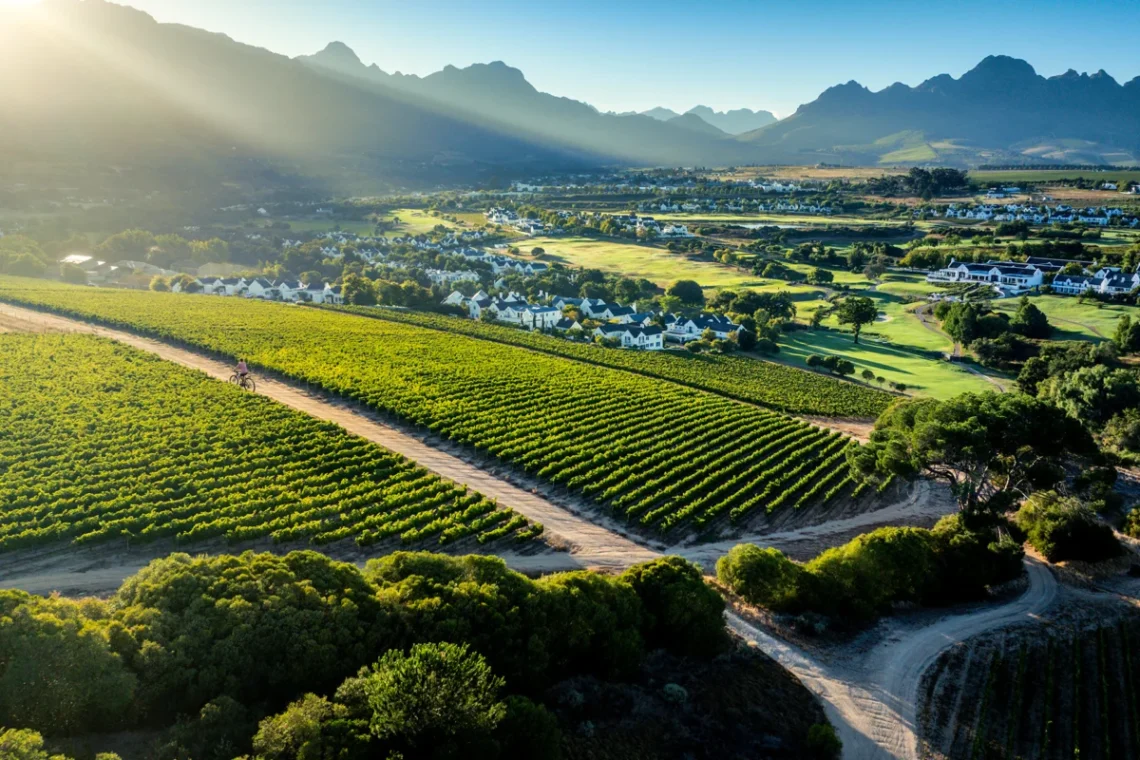
The Cape Winelands have evolved into a global outdoor-adventure hub. Stellenbosch offers a trifecta of road, gravel, and mountain bike trails. A popular route involves crossing the Helshoogte Pass, an undulating journey through the Simonsberg Mountains toward the village of Franschhoek.

Luxury estates like Delaire Graff have leaned into this trend, offering high-end accommodations that feature private pool terraces overlooking the very mountain passes cyclists traverse. Once in Franschhoek, a visit to the historic Boekenhoutskloof winery is essential to sample world-class Cabernet Sauvignon and Syrah.
4. Sonoma Valley, United States: A Diverse Playground
While Napa Valley garners significant fame, neighboring Sonoma County offers a more expansive, diverse terrain for cyclists. With 19 distinct AVAs, Sonoma provides a variety of backdrops ranging from redwood forests to coastal trails.
The Healdsburg area in North Sonoma is particularly well-suited for two-wheeled travel. West Dry Creek Road is a standout, offering a 10-mile stretch of low-traffic, gently rolling terrain. Stops like Lambert Bridge provide an elevated picnic experience in pristine gardens, while Reeve Wines offers a refined stop for Riesling enthusiasts.

5. Loire Valley, France: The Epicurean Route
The La Loire à Vélo trail is a staggering 560-mile route that serves as a masterclass in French heritage. It passes through Renaissance châteaux and riverside villages, but the true adventurer should look toward the Via Allier. Here, the Côtes d’Auvergne AOC offers volcanic hillsides that provide a unique terroir and a distinct, spicy profile for their Gamay and Pinot Noir wines, as exemplified by producers like Desprat Saint Verny.
6. Barossa Valley, Australia: The Sealed Path
The Barossa Trail is a 25-mile, sealed cycling path designed for those who prefer safety and consistency. With gentle gradients and frequent water stations, it is one of the most accessible wine-country rides in the world. The trail connects to the Gomersal route, leading to Seppeltsfield Wines, a historic estate known for its monumental architecture and its 100-point red blends.
7. Girona and the Empordà, Spain
Girona is widely considered one of the cycling capitals of the world, serving as a base for many professional racers. However, the surrounding Empordà region offers a rich cultural experience. Cyclists can navigate through cork forests and medieval villages before reaching the Mediterranean coast. The DO Empordà Wine Route connects over 30 wineries, where the focus is on robust Garnatxa Negra and Carinyena.

8. Willamette Valley, United States: The Pioneer Bikeway
Oregon’s Willamette Valley Scenic Bikeway holds the distinction of being the nation’s first official route of its kind. Covering 134 miles, the route weaves between the Coast and Cascade ranges. It is an agricultural odyssey, passing hop fields and hazelnut orchards. A stop at Ankeny Vineyard allows riders to sample the valley’s world-renowned Pinot Noir alongside wood-fired pizzas, a perfect mid-ride refueling strategy.
9. Tuscany, Italy: The Spiritual Home of Cycling
Cycling is woven into the very fabric of Tuscan life. With over 9,000 miles of routes, the region offers everything from peaceful rides along the ancient Via Francigena to the strenuous climbs of the Apennine Mountains. The quintessential image of a cyclist in Tuscany—pedaling past rows of cypress trees on white gravel roads—is a reality here. Whether it is the bold Sangiovese of Chianti Classico or the structured reds of Montalcino, Tuscany remains the gold standard for pairing physical effort with cultural indulgence.
Implications: A Sustainable Future for Wine Tourism
The integration of cycling into wine tourism is not just a trend; it is a shift toward a more sustainable and meaningful travel model. By choosing to move through a region under one’s own power, the traveler reduces their carbon footprint while engaging more deeply with the local economy.

As regions continue to invest in "velo-friendly" infrastructure, the marriage of cycling and viticulture is likely to expand. For the winery, it is a way to engage with a demographic that values wellness and sustainability. For the traveler, it is the ultimate reward: the perfect glass of wine, rendered infinitely better by the journey taken to reach it.