By Investigative Health Desk
For decades, public health guidelines have advised populations to consume more whole foods, eat less red and processed meat, and cut back on added sugars. However, a chorus of skepticism often echoes through corporate boardrooms and academic journals, questioning the legitimacy of these recommendations. The primary critique launched by food industry stakeholders centers on the reliability of observational nutrition science, arguing that because these studies are not randomized controlled trials (RCTs), their findings amount to little more than educated guesses.
This debate is not merely academic. It touches on billions of dollars in commercial revenue, public trust in regulatory bodies, and, ultimately, the chronic disease burdens of millions of people worldwide. As investigative inquiries into corporate influence reveal, the persistent campaign to discredit nutritional epidemiology relies on a fundamental misapplication of the drug-trial paradigm—a tactic weaponized by industries aiming to protect their bottom lines at the expense of public health.
Main Facts: The Clash Between Nutritional Science and Corporate Critiques
At the heart of the controversy is a methodological dispute over how evidence is gathered and evaluated. Randomized controlled trials are universally recognized as the gold standard for testing pharmaceutical interventions. In a clinical drug trial, researchers can administer a precise chemical compound to one group and a placebo to another, maintaining double-blind conditions to eliminate bias.
However, applying this exact model to human nutrition is fraught with insurmountable challenges:
- Time Horizons: Dietary diseases—such as cardiovascular disease, type 2 diabetes, and various cancers—take decades to develop.
- Behavioral Compliance: Humans cannot be fed "placebo food" in a controlled laboratory environment for years on end. Compliance with assigned diets inevitably decays over time.
- Hard Endpoints: Forcing human subjects to maintain high-risk diets for decades to observe "hard endpoints" like fatal heart attacks is both ethically indefensible and logistically impossible.
Because true randomized trials on long-term dietary habits are rarely feasible, nutrition science relies heavily on observational studies. These large-scale epidemiological investigations track hundreds of thousands of people over many years, correlating dietary patterns with health outcomes.
Corporate critics frequently point to these observational studies as "low-quality evidence." Yet, comparative analyses tell a different story. When researchers systematically compare data obtained from observational population studies against randomized controlled trials for the same interventions, the findings rarely diverge significantly. In roughly 90% of the treatments examined, the observed effects not only pointed in the same direction but were of the same general magnitude.
Where apparent discrepancies have occurred—such as early observations regarding hormone replacement therapy (HRT) where women taking Premarin appeared to have fewer heart attacks compared to later RCT findings showing the opposite—subsequent data analysis revealed that the differences stemmed entirely from timing and participant age, rather than an inherent failure of observational methods.
Chronology: A History of Methodological Manipulation
The friction between public health advice and corporate interests has a deep historical footprint, marked by deliberate strategies to reshape how science is evaluated.
1. The Trans Fat Precedent
Decades ago, nutritional science faced a critical test regarding trans fats. Researchers utilized a complementary approach: randomized trials demonstrated that trans fats negatively altered blood lipid profiles, increasing heart disease risk factors, while massive population studies showed a direct dose-response relationship between trans fat consumption and clinical heart disease.
Although scientists never conducted a multi-decade RCT forcing participants to consume daily canisters of hydrogenated oil, the combined body of evidence was overwhelmingly clear. Public health officials acted on the balance of probabilities, leading to the near-total removal of artificial trans fats from the global food supply and preventing an estimated 200,000 heart attacks annually.
2. The Sugar Industry Pivot
As public health entities began aggressively targeting added sugars in the early 2010s, the food industry adapted its defense strategies. In 2016, a high-profile paper—partially funded by corporate interests—concluded that dietary guidelines recommending sugar reduction were untrustworthy because they relied on "low-quality evidence."

The authors applied the GRADE (Grading of Recommendations Assessment, Development and Evaluation) framework, a system explicitly designed for evaluating pharmaceutical drugs, to broad nutritional guidelines. Because nutrition cannot always be reduced to a single, isolated pill in a double-blind trial, the GRADE system inevitably rated nutritional epidemiology as low quality.
Furthermore, the same paper utilized the natural evolution of dietary guidelines over a 20-year period to argue that recommendations were inconsistent and therefore unreliable. Yet, historical scrutiny revealed a telling detail: the primary outlier during that two-decade span was a 2002 Institute of Medicine guideline—partially funded by an institute backed by major beverage and confectionery corporations—which claimed that a quarter of the human diet could consist of added sugars without causing nutritional deficiencies.
3. The Red Meat Playbook
Following the playbook established by the sugar industry, subsequent challenges emerged regarding red and processed meat. In a nearly identical sequence of events, a meat-industry-funded institution hired the same methodology consultant who helped design the 2016 sugar-industry-funded paper.
Predictably, the resulting studies applied the drug-trial GRADE approach to nutritional epidemiology surrounding red meat and colorectal cancer. By forcing observational nutrition data through a pharmaceutical evaluation funnel, the authors concluded that current guidelines advising people to reduce meat consumption were based on "low quality" evidence and could therefore be safely ignored.
Supporting Data: Risk, Reward, and Standards of Proof
To understand why applying pharmaceutical standards to food is illogical, one must examine the vastly different risk profiles of drugs versus dietary choices.
| Intervention Type | Primary Risk Profile | Standard of Evidence Required | Appropriate Evaluation Tools |
|---|---|---|---|
| Pharmaceutical Drugs | High risk; adverse drug reactions are a leading cause of death (e.g., ~100,000 annual fatalities in the U.S. even when taken as directed). | Absolute certainty required; double-blind, randomized, placebo-controlled trials. | GRADE framework |
| Nutritional Guidance | Low risk; advising individuals to eat more broccoli, reduce soda intake, or cut back on donuts. | Balance of best available evidence from multiple methodologies. | NutriGrade, HEALM (Hierarchies of Evidence Applied to Lifestyle Medicine) |
Public health policy operates on the same principle applied to other inescapable environmental exposures. For instance, society does not wait for randomized, double-blind trials where children are deliberately exposed to varying levels of lead or PCBs to determine safe upper limits. Such experiments are entirely unethical and impossible. Instead, toxicologists and public health officials pull evidence from laboratory mechanisms, animal models, and observational human data to establish protective thresholds.
Recognizing that pharmaceutical evaluation tools like GRADE are fundamentally broken when applied to lifestyle medicine, researchers developed specialized scoring systems:
- NutriGrade: A scoring system specifically tailored for nutrition research that explicitly accounts for funding bias, automatically downgrading the credibility of industry-funded trials.
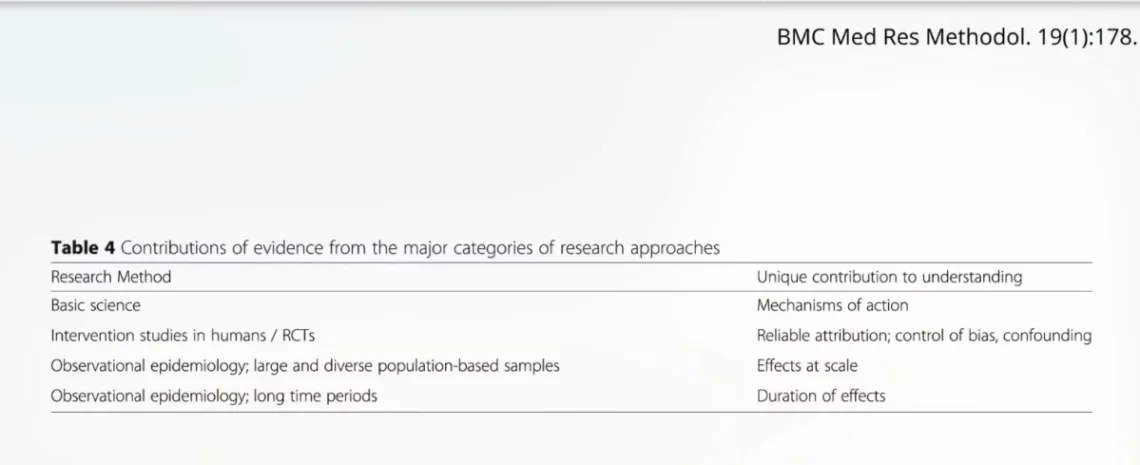
- HEALM (Hierarchies of Evidence Applied to Lifestyle Medicine): Created to address questions that cannot be fully answered through randomized controlled trials, recognizing that laboratory science, clinical trials, and massive population studies each play an indispensable, complementary role.
Official Responses and Industry Defense
Representatives from food and agriculture trade associations have consistently defended their funding of academic research, arguing that transparency is maintained and that their primary goal is ensuring scientific rigor and accuracy in public policy. Industry defenders argue that public health recommendations carry profound economic consequences for agricultural producers and food manufacturers, making it imperative that policy decisions rest on the most rigorous empirical foundations possible.
Conversely, independent epidemiologists and public health advocates counter that demanding pharmaceutical-grade certainty for dietary advice is a deliberate stalling tactic. By setting an impossibly high evidentiary bar that observational nutrition can never clear, corporate sponsors can successfully paralyze regulatory action, ensuring that dietary guidelines remain weak, vague, or heavily caveated.
Implications: Letting the Perfect Be the Enemy of the Good
The persistent weaponization of scientific methodology by corporate entities poses severe risks to global health. If public health institutions capitulate to the demand that dietary guidelines must rely exclusively on long-term randomized controlled trials, evidence-based nutrition policy would effectively grind to a halt.
As chronic non-communicable diseases—driven in large part by poor dietary patterns—continue to strain healthcare systems worldwide, waiting for "perfect" data is a luxury society cannot afford. Public health officials must continue to weigh the cumulative balance of evidence, utilizing mechanistic laboratory data, clinical trials, and robust observational studies in tandem.
Ultimately, the debate over observational studies in nutrition is not a dispute over scientific integrity; it is a battle over public accountability. When corporate playbooks successfully reframe common-sense dietary advice as "unreliable," the ultimate casualty is not academic theory, but the long-term well-being of the general public.