By Lydia Price
September 25, 2026
The convergence of two seemingly disparate worlds—the refined, sedentary art of wine tasting and the high-octane physical demands of competitive cycling—has birthed a new, booming travel sector: the "Velo-Oenophile" movement. It is no coincidence that the geographic topography required for championship-caliber cycling—steep, dramatic elevation changes, diverse micro-climates, and winding, scenic vistas—mirrors the specific "terroir" that produces the world’s most acclaimed vintages.

As travelers increasingly prioritize immersive, active lifestyles over traditional sightseeing, the marriage of the bicycle and the vineyard has evolved from a niche hobby into a global travel phenomenon.
The Growth of the Active Wine Escape
The data reflects a distinct shift in consumer behavior. According to industry leaders, the appetite for bike-and-wine excursions is not merely a trend, but a sustained growth trajectory. Katy Rockett, regional director of North America at the prominent tour operator Explore Worldwide, notes that their Portugal-based itineraries are seeing explosive demand.

"Our Porto to Lisbon cycling trip has seen bookings increase 31% year over year, while our Lisbon to Algarve trip is also seeing growth, with bookings up 40%," says Rockett. "Traveling by bike puts you directly into the landscape, riding through vineyards, agricultural areas, villages, and smaller communities. There is a much stronger connection between the wine you’re tasting and the place it comes from when you’ve earned that glass through miles in the saddle."
This sentiment is echoed by luxury hospitality providers. Dagmar Lombard, general manager of Hôtel Crillon le Brave in southeastern France, believes that technology has been the great equalizer. "Pairing cycling with wine tourism answers a growing demand for immersive, active experiences," Lombard explains. "The rise of the electric bike has made it far more accessible—both for exploring the vineyards around us and for taking on a professional-level challenge like the ascent of Mont Ventoux."

The Global Circuit: Nine Prime Destinations
From the sun-drenched hills of Provence to the rugged coastal paths of South Africa, the world’s premier wine regions are rapidly upgrading their infrastructure to cater to this new class of traveler.
1. Provence, France: The Cyclist’s Playground
Provence offers a synthesis of history and athleticism. The region is home to the grueling Mont Ventoux, a recurring feature of the Tour de France. The summit, with its otherworldly, white limestone "moonscape," provides a psychological and physical peak for the serious cyclist. Below the mountain, the region offers a more pastoral experience, characterized by lavender fields and ancient Roman roads.

Hôtel Crillon le Brave exemplifies the modern trend, having earned the Accueil Vélo certification. The property caters specifically to guests with secure storage, rental delivery services, and post-ride spa recovery treatments. After descending the mountain, travelers find the region’s signature mineral-tinged rosés to be the perfect restorative beverage.
2. The Douro Valley, Portugal: A Test of Endurance
For those seeking a true challenge, the UNESCO World Heritage-listed Douro Valley is the ultimate proving ground. The terrain here is unforgiving, defined by steep, schist-cut slopes that force cyclists to confront constant, punishing gradients. However, the reward is immense. The valley is the historic heart of Port production and an emerging center for high-quality dry table wines. Touring the quintas—historic estates like the 800-acre Quinta do Vesúvio, managed by Symington Family Estates—allows riders to sample world-class vintages while overlooking the winding Douro River.

3. Stellenbosch and Franschhoek, South Africa
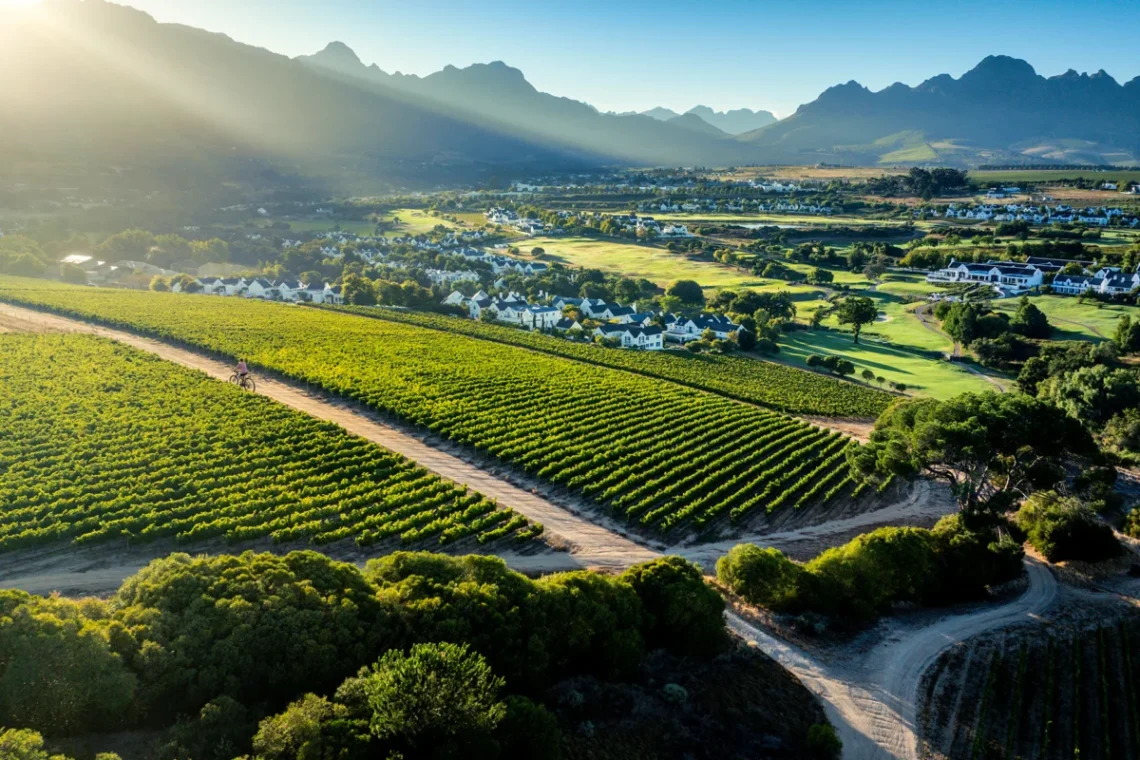
The Cape Winelands have transformed into a global outdoor-adventure hub. Stellenbosch provides a versatile landscape, offering a mix of road, gravel, and dedicated mountain bike trails. The ride from the Simonsberg Mountains via the Helshoogte Pass toward Franschhoek is widely considered one of the most beautiful cycling routes in the world. Luxury estates, such as Delaire Graff, have integrated themselves into this ecosystem, offering high-end villas where cyclists can recover in comfort.
4. Sonoma County, United States
While Napa Valley often captures the spotlight, Sonoma is the preferred destination for the cycling set due to its vast network of bike-friendly roads and 19 distinct AVAs. The Healdsburg and Dry Creek Valley corridor is a standout, offering a 10-mile stretch of quiet, rolling roads punctuated by boutique wineries like Lambert Bridge and Reeve Wines. It is a region that rewards the curious, with varied terrain ranging from redwood forests to coastal paths.

5. Loire Valley, France
For the long-distance touring enthusiast, the La Loire à Vélo route is essential. Spanning 560 miles, the trail tracks the Loire River through a landscape of Renaissance châteaux and lush vineyards. For those seeking a unique twist, the region’s volcanic hills—specifically the Côtes d’Auvergne AOC—offer a rare opportunity to pair cycling with volcanic-soil-derived Gamay and Pinot Noir, continuing a winemaking tradition that dates back to the Roman era.
6. Barossa Valley, Australia
The 25-mile Barossa Trail is a model for accessible wine-country cycling. Unlike the high-intensity climbs of Europe, this sealed path is designed for leisure, featuring water stations, public facilities, and gentle gradients. The trail connects to the Gomersal route, leading riders to historic landmarks like Seppeltsfield Wines, where the intersection of viticultural excellence and Australian hospitality is on full display.

7. Girona and the Empordà, Spain
Girona is legendary in the professional cycling world, serving as a training base for many elite athletes. The surrounding Empordà region offers a perfect secondary experience for recreational riders. Whether tackling the rolling secondary roads or venturing onto the gravel paths of the Pirinexus loop, cyclists are never far from the Mediterranean. The DO Empordà Wine Route provides a curated guide to the region’s Garnatxa Negra and Carinyena, best enjoyed at the end of a long ride near the Pyrenees foothills.
8. Willamette Valley, United States
Oregon’s Willamette Valley Scenic Bikeway is the premier long-distance trail in the American Northwest. Covering 134 miles, the route winds through hazelnut orchards and hop fields, passing by essential stops like Ankeny Vineyard. It offers a meditative, landscape-focused experience that culminates in the world-class Pinot Noirs for which the valley is famous.

9. Tuscany, Italy
Tuscany remains the spiritual home of the bike-and-wine enthusiast. With over 9,000 miles of routes, the region accommodates everyone from the casual day-tripper to the alpine-grade climber. Cycling here is an act of cultural immersion—riding along the white gravel strade bianche (white roads) lined with cypress trees, through medieval villages that have been producing Sangiovese for centuries.
Implications for the Future
The marriage of cycling and wine tourism has significant implications for the hospitality industry and regional economies. As travelers gravitate toward "slow travel," wine regions that invest in cycling infrastructure—secure parking, bike-friendly lodging, and well-marked routes—are capturing a larger share of the affluent, health-conscious demographic.

Furthermore, the environmental impact of this trend is positive. By promoting non-motorized transport between tasting rooms, these regions are reducing their carbon footprint while encouraging a more intimate exploration of their viticultural landscapes.
As we look toward the 2027 season and beyond, the trend shows no sign of slowing. The "Velo-Oenophile" has proven that the best way to understand a bottle of wine is not just to read its label or sit in its cellar, but to traverse the very earth from which its grapes were harvested. Whether it is the grueling climb of Mont Ventoux or the gentle flow of the Barossa Trail, the future of wine travel is, quite literally, in motion.