
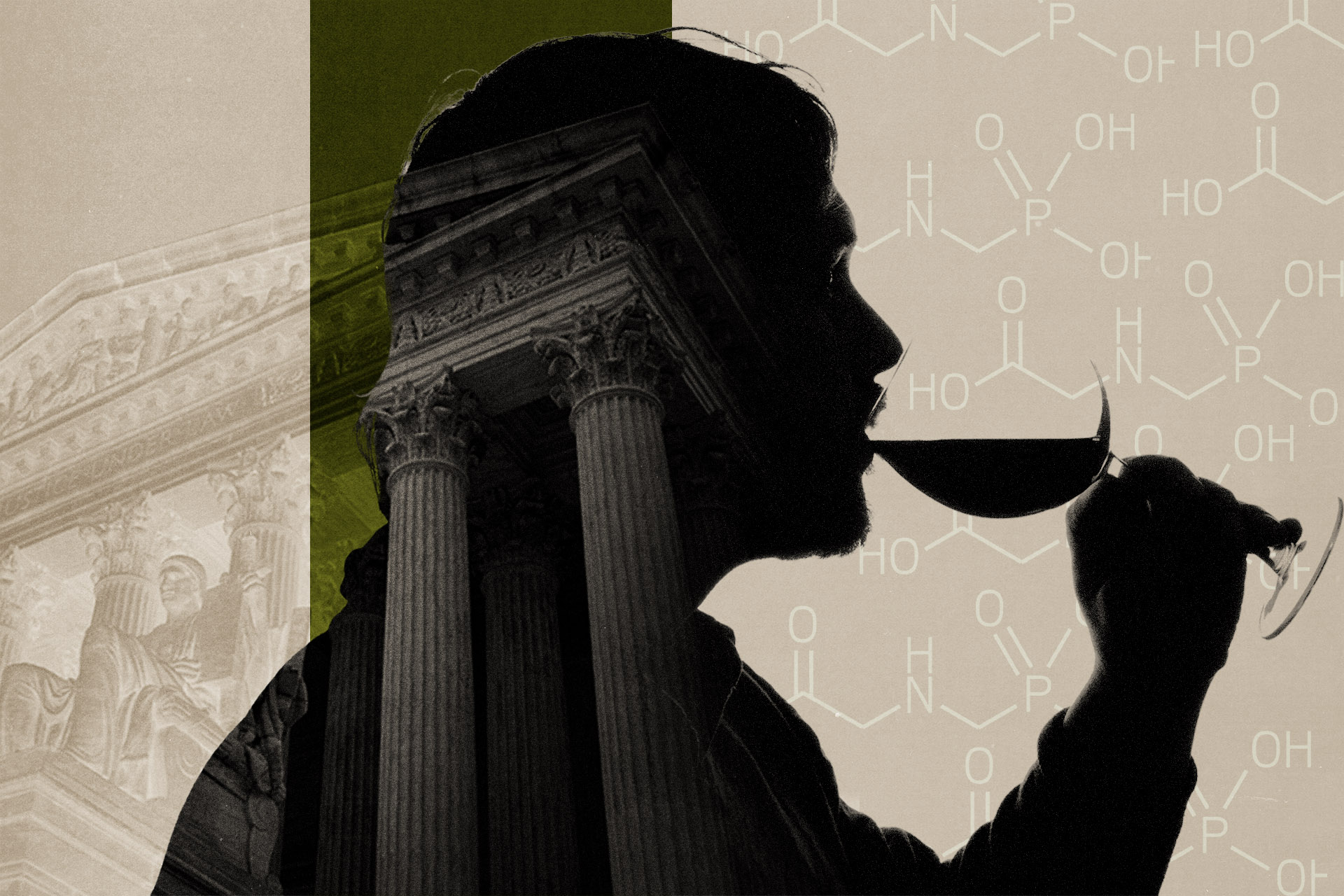
In a landmark decision delivered in late June 2026, the United States Supreme Court issued a 7-2 ruling in Monsanto v. Durnell, a case that effectively shields Bayer—the parent company of agrochemical giant Monsanto—from a deluge of future liability claims regarding its flagship herbicide, Roundup. The ruling marks a decisive turning point in a decades-long legal and scientific tug-of-war, setting a federal precedent that prioritizes uniform regulatory standards over individual state-level mandates for cancer warnings on agricultural products.
The decision has sent shockwaves through the corridors of power and the fields of the American heartland, drawing sharp criticism from a diverse coalition of environmentalists, consumer advocacy groups, and even proponents of the "Make America Healthy Again" (MAHA) movement. As the dust settles on this high-stakes legal battle, the implications for the wine industry, soil health, and the broader food supply chain remain a subject of intense, often polarized, debate.
The Genesis of a Legal Titan
Monsanto v. Durnell originated in a 2019 Missouri state court, where gardener John Durnell alleged that his long-term exposure to Roundup—specifically its primary active ingredient, glyphosate—directly caused his diagnosis of non-Hodgkin lymphoma. Durnell’s legal team centered their argument on the principle of "failure to warn," contending that Monsanto knowingly concealed potential carcinogenic risks from the public.
For over a decade, Monsanto has been embroiled in more than 100,000 similar lawsuits, with roughly 60,000 cases still pending. Despite Bayer’s steadfast insistence that their product is safe when used according to label instructions, the company has already paid out upwards of $10 billion in settlements to cancer victims. By ruling in favor of Monsanto, the Supreme Court has effectively halted the momentum of these individual and class-action lawsuits, potentially saving the corporation billions of dollars in future litigation.
Chronology of a Regulatory Conflict
The path to this Supreme Court decision was paved with years of conflicting data and shifting political tides:
- The 2015 Classification: The World Health Organization’s International Agency for Research on Cancer (IARC) famously classified glyphosate as "probably carcinogenic to humans," sparking a global outcry.
- The EPA’s Stance: Conversely, the U.S. Environmental Protection Agency (EPA) has consistently maintained that there is no risk to human health when the chemical is applied according to label instructions, a stance they have reaffirmed repeatedly despite public pressure.
- The Legal Escalation: Between 2019 and 2025, various state courts ruled in favor of plaintiffs, leading to massive compensatory and punitive damages. This created a "patchwork" of legal risk that threatened the financial stability of agricultural chemical suppliers.
- The Supreme Court Intervention (2026): By invoking the "uniformity" clause of the Federal Insecticide, Fungicide, and Rodenticide Act (FIFRA), the Court ruled that states cannot require warning labels that exceed federal EPA standards, effectively neutralizing state-level efforts to hold companies accountable through local legislation.
Supporting Data: Is Glyphosate Ubiquitous?
The debate over glyphosate is complicated by its sheer prevalence in the modern environment. Critics of the herbicide point to its detection in water systems and food supplies as evidence of an uncontrollable ecological footprint.
Recent data paints a startling picture:
- Food Supply: Over a two-year longitudinal study, the FDA detected glyphosate in 59% of corn and soy samples tested.
- Human Exposure: The Centers for Disease Control and Prevention (CDC) estimates that roughly 81% of the U.S. population has detectable levels of glyphosate in their system, a figure that includes both agricultural workers and the general public.
- Water Quality: A U.S. Geological Survey report found the herbicide in 66 out of 70 tested streams and rivers, highlighting its tendency to leach into ground and surface water.
- The "Beer and Wine" Study: A 2019 investigation by the U.S. Public Interest Research Group (PIRG) found that 19 out of 20 tested grocery store wines and beers contained measurable traces of the chemical.
The Wine Industry’s Dilemma
Perhaps nowhere is the battle over glyphosate more contentious than in the world of viticulture. Winemakers are caught between the economic necessity of high-yield farming and the rising consumer demand for "clean," organic, and sustainable products.
The Cost of Going Chemical-Free
Proponents of traditional agricultural methods argue that without glyphosate, the costs of managing vineyards would skyrocket. Mechanized weeding requires more tractor passes, leading to increased fuel consumption, higher carbon emissions, and a greater demand for manual labor—a resource that is already in short supply globally.
Diego Tomasi, director of the Consorzio di Tutela del Vino Conegliano Valdobbiadene Prosecco DOCG, notes that even regions that have successfully banned the chemical are feeling the pressure. "Today, in light of the increasingly unsustainable costs of managing heroic vineyards, some winegrowers are beginning to call for the reintroduction of glyphosate," Tomasi admits.
The Human Toll
Despite the economic arguments, the human stories remain haunting. Nick Dugmore, founder of Stoke Wines in Australia, offers a visceral account of his experience. After being exposed to the chemical in his own vineyard, he developed painful rashes followed by a Stage 4 cancer diagnosis. Dugmore’s story is echoed by hundreds of others, fueling the push for reform within the industry.
Official Responses and Political Maneuvering
The political response to the Supreme Court ruling has been characterized by a sharp divide. The Trump administration, in an effort to stabilize the agricultural sector, issued an executive order in February 2026 calling for increased domestic production of glyphosate, citing it as essential for national security and food supply chain integrity.
Robert Francis Kennedy Jr., serving as Secretary of Health and Human Services, found himself in a complex position. While he has previously expressed personal beliefs that glyphosate is carcinogenic, he defended the administration’s support for the chemical’s production. In a statement posted to X, Kennedy noted, "If these inputs disappeared overnight, crop yields would fall, food prices would surge… The consequences would be disastrous."
However, this stance has drawn fire from grassroots movements. David Murphy, spokesperson for the "Make America Healthy Again" (MAHA) movement, expressed deep disillusionment, telling The Hill, "A lot of MAHA voters are realizing they’ve been snookered… by Republicans that had no intention of protecting their health."
Implications: A Future Defined by Labels
The ruling effectively removes the burden of warning labels from manufacturers, shifting the onus onto consumers and private certification bodies. Industry professionals like Adam Casto of Ehlers Estate in Napa Valley suggest that third-party certifications, such as "USDA Organic," will become the gold standard for consumer trust.
"Consumers need to be aware of the devastating effects on their health and the health of soil," says Ivo Jeramaz of Grgich Hills Estate. "There is nothing worse for the vitality of your soil than spraying glyphosate. It kills all life, resulting in a fragile, fertilizer-dependent system."
As the EPA approaches an October 1, 2026, deadline to re-examine the safety of the chemical, the scientific community remains divided. The retraction of a prominent 25-year-old study—which had long been used to support the safety of glyphosate—due to revelations of improper influence by Monsanto scientists, has only served to deepen public skepticism.
Conclusion: The Path Forward
The Supreme Court’s decision in Monsanto v. Durnell provides legal certainty for a chemical giant, but it does little to soothe the growing unease among the public. While the ruling may have ended the immediate threat of a massive legal reckoning, it has invigorated a push for transparency and sustainability that is likely to persist for years.
For the wine industry and the agricultural sector at large, the future appears to be bifurcating: one path continues to rely on the established, low-cost convenience of glyphosate, while the other bets on the long-term value of soil health and organic practices. As the EPA’s upcoming review looms, the debate over glyphosate—once confined to courtrooms—is now firmly rooted in the marketplace, where consumers, with every bottle they purchase and every meal they eat, continue to cast their own votes on the future of the food they consume.