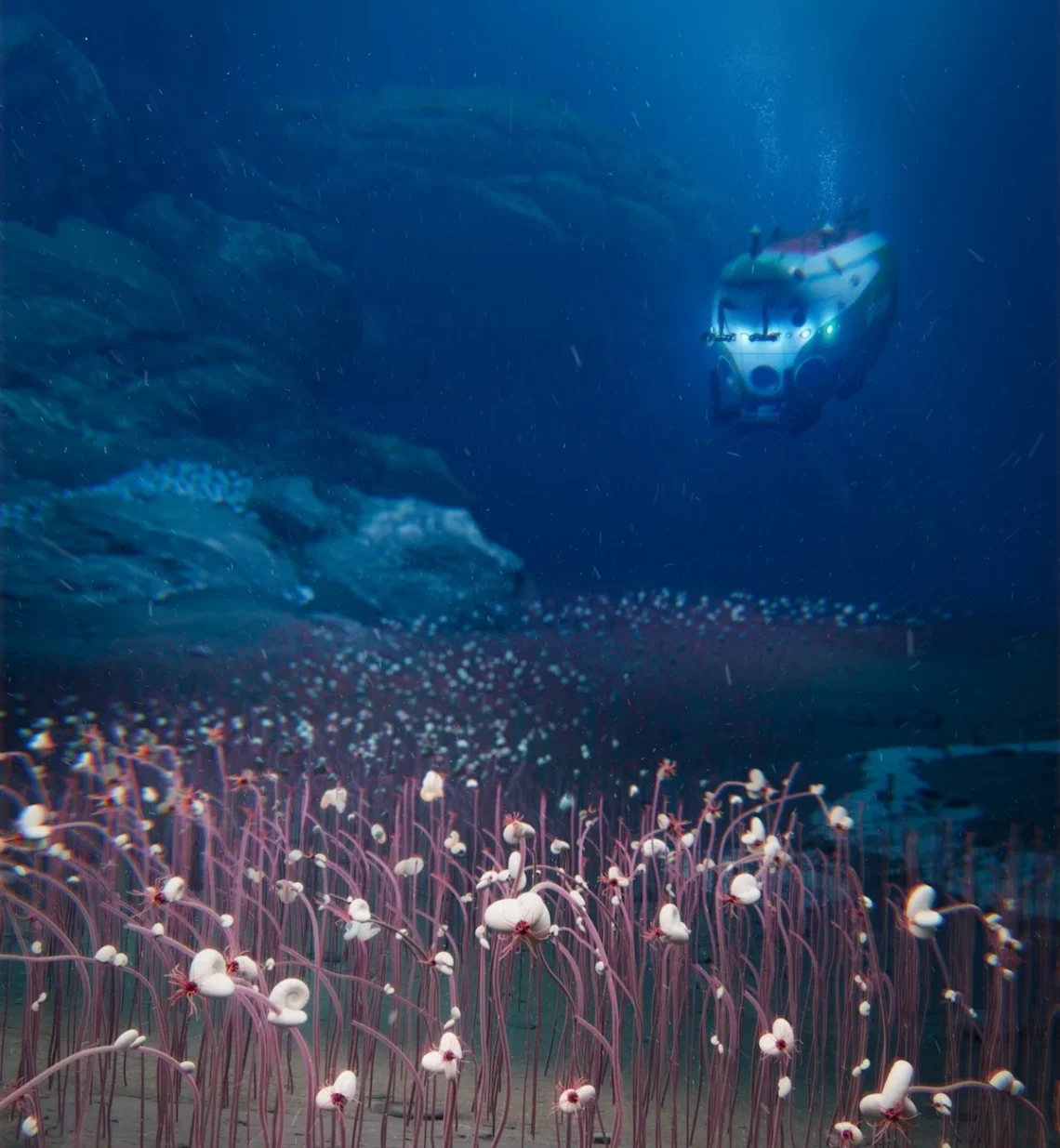
In a landmark revelation that fundamentally alters our understanding of the biosphere, researchers have identified the deepest-known animal colonies on Earth. A team of scientists, utilizing the advanced Chinese manned submersible Fendouzhe, has documented an expansive, thriving ecosystem of mollusks, tubeworms, and crustaceans nearly six miles beneath the surface of the Pacific Ocean. This discovery, published in the journal Nature, challenges long-held assumptions about the limits of life, revealing that the "hadal" trenches—once thought to be desolate, barren voids—are in fact home to vibrant, complex biological communities.
Main Facts: A New Frontier in the Mariana Trench
The expedition, which conducted 23 dives into the western Pacific’s Mariana Trench last year, unveiled a landscape far more hospitable than previously imagined. At depths ranging from 3.6 to 5.92 miles, scientists observed thousands of organisms flourishing in total darkness.
Unlike surface ecosystems that rely on photosynthesis, these creatures survive through chemosynthesis. In the absence of sunlight, these organisms derive their energy from chemical fluids rich in hydrogen sulfide and methane. These fluids are transported along deep-seated geological faults, where microbes break down organic matter trapped in sediment, fueling a food web that supports complex life forms.
The primary inhabitants identified by the Fendouzhe team include:
- Siboglinid Polychaeta: Tubeworms reaching lengths of up to one foot.
- Bivalvia: Extensive beds of clams and mollusks.
- Invertebrate Biodiversity: The team also cataloged sea lilies, sea cucumbers, spiky crustaceans, and various free-floating marine worms.
Chronology: From Desolation to Discovery
The exploration of the hadal zone has been a slow and perilous endeavor. For decades, the deepest trenches were viewed as "biological deserts."
- 1960: The first human descent into the Mariana Trench occurred, providing a brief, grainy glimpse into the bottom of the ocean.
- 2012: Filmmaker James Cameron completed a historic solo dive, describing the environment as "desolate" and "alien," reinforcing the perception that life at those pressures and depths was sparse and primitive.
- 2024-2025: The Fendouzhe expedition conducted a series of systematic dives, utilizing high-definition imaging and isotopic sampling to map the seafloor.
- July 2025: The findings were formally published in Nature, detailing the 1,553-mile-long stretch of life-sustaining habitat across the Kuril-Kamchatka and western Aleutian Trenches.
This trajectory reflects a shift in deep-sea research: moving from "first-contact" exploration to long-term environmental monitoring. The data collected by the Fendouzhe represents the most comprehensive study of hadal biology to date.
Supporting Data: The Mechanics of Extreme Survival
The scientific rigor behind this discovery provides a new framework for carbon cycling in the deep ocean. Lead author Xiatong Peng and co-author Mengran Du, both associated with the Institute of Deep-sea Science and Engineering at the Chinese Academy of Sciences, utilized isotopic analysis to confirm the origin of the chemical nutrients.
The Role of Methane
The study provides "compelling evidence" that microbial activity is the engine of this ecosystem. Methane produced by microbes within the deep sediment layers seeps through the seafloor, creating "snow-like" microbial mats. These mats act as a primary food source for the tubeworms and other invertebrates, which cluster around these chemical vents in a symbiotic relationship.
Geographical Scale
The discovery is not an isolated pocket of life. The researchers mapped these communities across a distance of over 1,500 miles. This suggests that the geological conditions required to support this life—fault-driven fluid transport—are widespread across the Earth’s hadal trenches, implying that thousands of similar "oases" may exist globally, hidden in the deepest folds of the ocean floor.

Official Responses and Expert Commentary
The scientific community has lauded the discovery as a "groundbreaking" shift in marine biology.
"What makes our discovery groundbreaking is not just its greater depth—it’s the astonishing abundance and diversity of chemosynthetic life we observed," stated Mengran Du. "Unlike isolated pockets of organisms, this community thrives like a vibrant oasis in the vast desert of the deep sea."
The sentiment is echoed by marine biologists worldwide who were not involved in the study. The ability for complex, multi-cellular organisms to thrive under extreme hydrostatic pressure (reaching up to 1,000 times the atmospheric pressure at sea level) forces a re-evaluation of the "habitable zone" for complex life. The researchers noted that their findings "challenge the current models of deep-ocean carbon cycling," suggesting that the deep sea plays a much more active role in the Earth’s planetary life-support systems than previously acknowledged.
Implications: The Looming Threat of Deep-Sea Mining
While the scientific community celebrates this breakthrough, it arrives at a critical juncture in global environmental policy. As international bodies and corporations debate the viability of deep-sea mining, the discovery of such extensive, fragile ecosystems provides a stark warning.
The Fragility of the Deep
Deep-sea mining seeks to extract valuable minerals—such as cobalt, manganese, and nickel—from the seafloor, often targeting hydrothermal vents and deep-sea sediment plains. The discovery that these areas are not barren, but are instead home to complex biological communities, complicates the argument for industrial exploitation.
"Mining the little-explored ocean floor could destroy fragile marine ecosystems in one of the last wild zones on the planet," warn oceanographers. Because these organisms grow at an extremely slow rate due to the cold and high-pressure environment, recovery from industrial disturbance could take centuries, if it is possible at all.
Regulatory Deadlock
The International Seabed Authority (ISA) is currently under immense pressure to finalize regulations that would govern deep-sea mining. The new data from the Mariana Trench serves as a "red flag" for conservationists, who argue that before a single shovel of sediment is disturbed, we must understand the full extent of the life that exists there. The Fendouzhe expedition proves that the deep ocean is not a blank slate, but a complex, interconnected web of life that may be critical to the health of the global ocean.
Conclusion: A Hidden World Unveiled
The Fendouzhe mission has done more than just identify new species; it has fundamentally expanded the boundaries of our living planet. By unveiling a hidden world where life thrives in defiance of darkness and pressure, the researchers have reminded us that the deepest parts of our ocean are not "alien" landscapes, but rather essential, vibrant components of the Earth’s biology.
As we look toward the future, the challenge lies in balancing our need for resources with the responsibility to protect these "deep-sea oases." The mystery of the abyss is slowly being unraveled, but as Mengran Du noted, every descent into the trench feels like "traveling through time." We are just beginning to understand the history of life on Earth, and it appears that much of that history is written in the silence of the deep.