By Michael Greger, M.D., FACLM
Published: August 13, 2026
Main Facts: Measuring the Immeasurable
Human beings are notoriously poor at evaluating statistical probability. When confronted with medical statistics—such as a surgeon informing a patient that an upcoming operation carries a “half-percent chance of mortality”—patients frequently retreat to cognitive defense mechanisms. A common refrain is, "I could die just as easily crossing the road," revealing a fundamental misunderstanding of the vast gulfs between everyday hazards and clinical interventions.
To bridge this comprehension gap, decision-makers, actuaries, and medical ethicists rely on a specialized unit of measurement: the micromort (mM). Defined as a one-in-a-million chance of death, the micromort provides a standardized, universal metric to compare the lethal risks of diverse human activities. Whether evaluating the statistical hazard of going under general anesthesia, driving an automobile, or undergoing elective surgery, the micromort translates abstract percentages into digestible, comparable integers.
Chronology and Evolution of Risk Communication
The concept of the micromort did not emerge in a vacuum. It was developed to counteract the historic opacity of medical and occupational risk communication.

- The Pre-Statistical Era: For centuries, patients accepted surgical or therapeutic risks based purely on qualitative assurances from physicians. "Safe" and "dangerous" were subjective descriptors rather than quantified probabilities.
- The Rise of Actuarial Science: Mid-20th-century advancements in insurance, aviation, and industrial safety necessitated precise risk quantification, giving rise to statistical tracking of operational hazards.
- Introduction of the Micromort: Coined in the late 20th century, the micromort framework allowed researchers to express low-probability, high-consequence events uniformly. Suddenly, a skydive could be equated mathematically to a specific mileage driven in an automobile.
- Modern Integration (2026 and Beyond): Today, public health advocates like Dr. Michael Greger utilize the micromort framework to help patients navigate modern health choices—ranging from elective cosmetic procedures and cancer treatments to lifestyle choices—by placing rare complications into clear, rational perspectives.
Supporting Data: Comparing the Incomparable
Human intuition often fails when gauging what constitutes a "safe" versus a "dangerous" activity. By converting various life events into micromorts, researchers have mapped out a startling landscape of everyday hazards.
The Baseline of Existence
Every day of normal life carries an inherent baseline risk of accidental death—roughly one micromort per day based on U.S. national averages. Of that daily baseline, approximately half is attributable to vehicular accidents. However, other daily hazards exist in the background of modern life; epidemiological data reveals that Americans face roughly a 1-in-200,000 chance annually of dying from a foreign body entering an orifice other than the mouth.
Transportation Hazards
How we travel dictates our exposure to micromorts:
- Driving 100 miles: ~1 micromort
- Riding in a car vs. motorcycle: Riding a motorcycle is roughly 50 times deadlier than traveling the same distance in a car.
- Cycling: Commuting by bicycle carries an immediate risk roughly 10 times higher than driving over the same short-term distance.
- Trains vs. Planes: Commercial aviation and rail travel present virtually identical safety profiles when measured across equivalent distances.
- Extreme Travel: Climbing Mount Everest is roughly 30 times riskier than high-hazard industrial work like coal mining or extreme sports like base jumping.
Medical Procedures and Anesthesia
Going under general anesthesia carries roughly a 1-in-100,000 chance of fatal complication—equivalent to the risk profile of an expert skydive. Yet, surgical interventions vary wildly in their baseline risk:
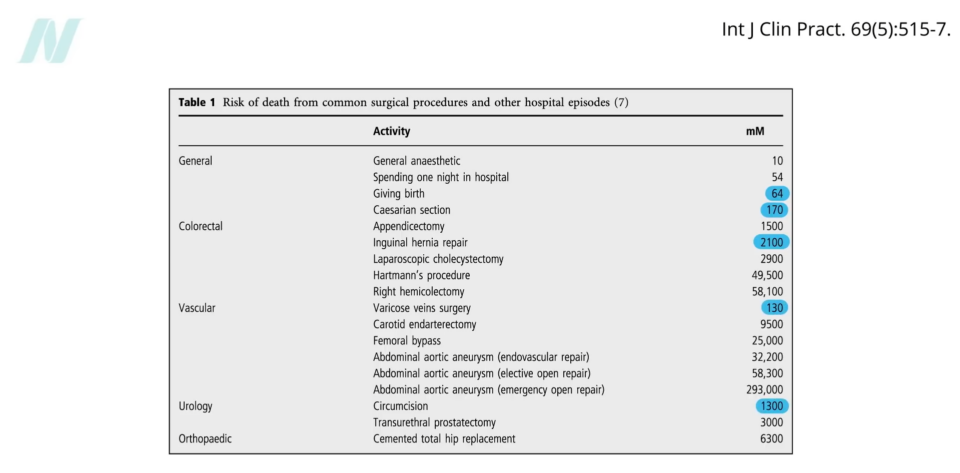
- Giving birth (vaginal): Carries a risk equivalent to driving a car from New York to Los Angeles and back.
- Caesarean sections (C-sections): More than twice as risky as a standard vaginal delivery.
- Hernia repairs: Statistically carries a mortality risk comparable to skydiving 200 times.
- Varicose vein surgery and circumcisions: While often elective, these procedures carry non-zero micromort totals that patients must weigh against quality-of-life benefits.
- Oncological Interventions: Advanced therapies for aggressive conditions—such as chemotherapy and radiation for head and neck cancer—can accumulate hundreds of thousands of micromorts, representing risks vastly exceeding extreme recreational sports, yet justified by the terminal nature of the underlying disease.
Recreational and Lifestyle Comparisons
- Scuba Diving: ~5 micromorts per dive (roughly equivalent to driving 500 miles).
- Horseback Riding: Statistically calculated to be approximately four times deadlier per hour of engagement than rock climbing.
- Skiing: A single day on the ski slopes carries a measurable micromort total that is frequently used as a benchmark for evaluating rare medical complications.
Official Responses and Medical Implications
The application of the micromort to clinical medicine has triggered profound discussions regarding informed consent, patient autonomy, and the ethics of medical intervention.
The Patient Perspective
When patients are presented with abstract risk percentages—such as a 0.5% mortality rate for an operation—their cognitive biases often take over. They may reject life-saving interventions out of irrational fear, or conversely, casually consent to elective procedures with high cumulative micromorts without fully grasping the hazard. By translating these percentages into familiar units (e.g., "This surgery carries the same statistical risk as 50 skydives"), clinicians can foster truer, more transparent informed consent.
The Paradox of Medical Intervention
A striking implication of modern healthcare data is the sheer scale of iatrogenic risk. Statistically, medical interventions and physician-led care rank among the leading causes of death in developed nations—not due to negligence, but due to the inherent lethality of treating advanced, failing human biology. As highlighted in public health analyses regarding preventative care versus reactive medicine ("Why Prevention Is Worth a Ton of Cure"), avoiding chronic disease through lifestyle medicine drastically reduces a patient’s cumulative lifetime exposure to high-micromort medical environments.
Case Study: Breast Implant-Associated Lymphoma
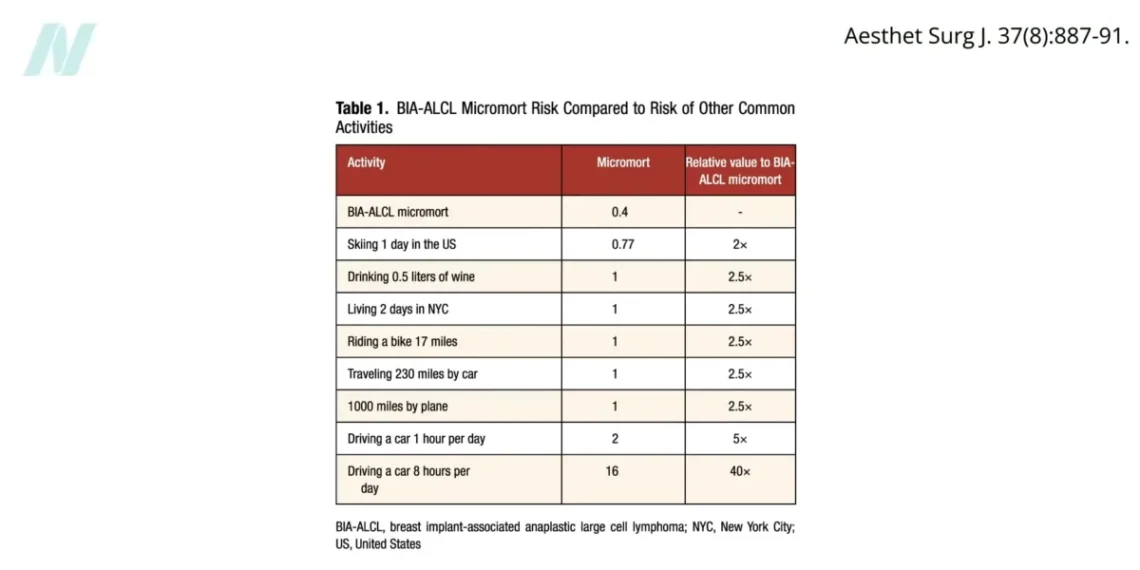
Consider the anxiety surrounding rare medical phenomena, such as a specific type of breast implant-associated lymphoma linked to certain types of breast implants. Millions of women globally live with implants, and the potential association with cancer generates profound psychological distress.
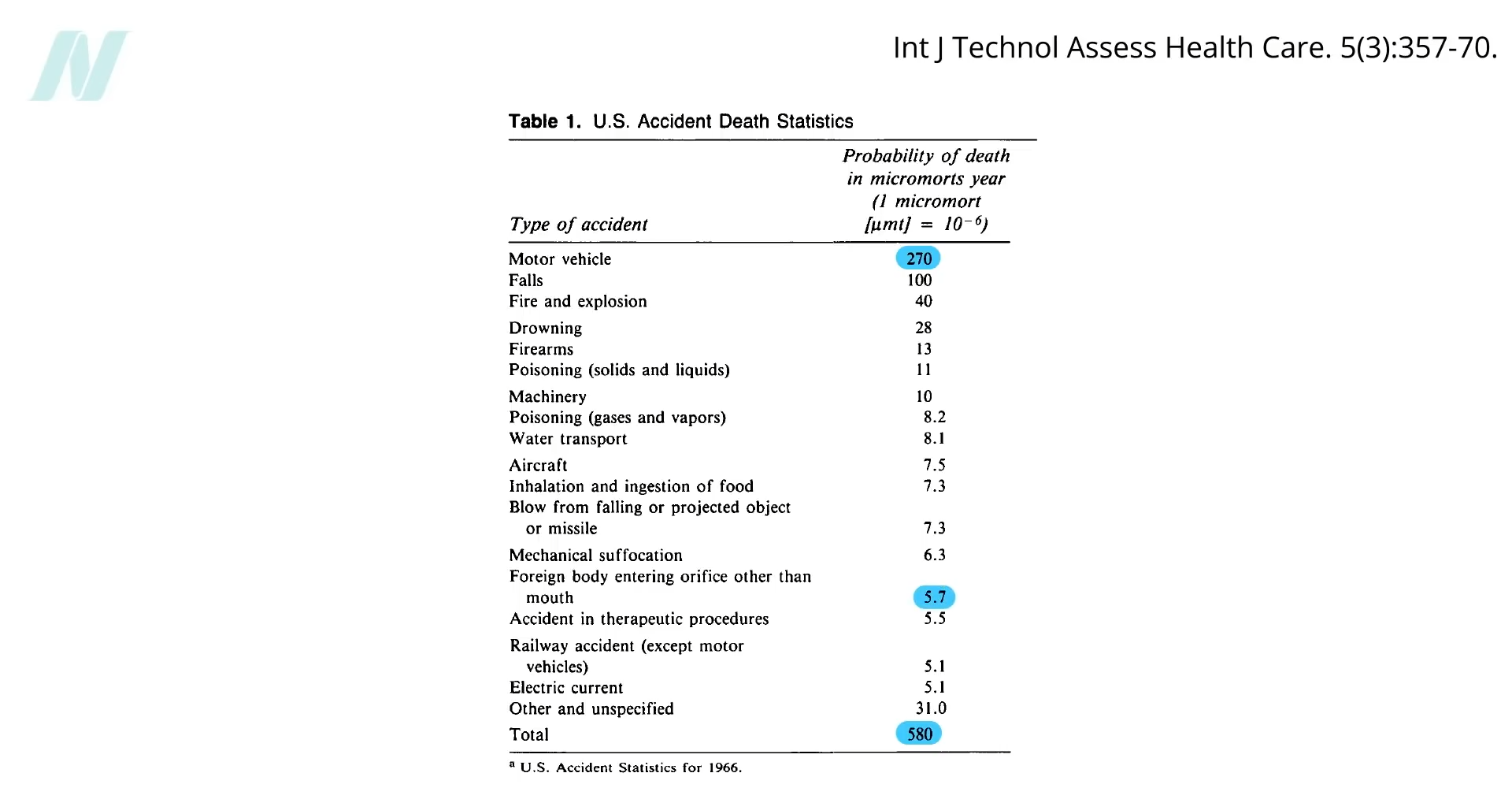
However, when evaluated through the lens of micromorts, the statistical risk of dying from this specific implant-associated cancer is less than the risk accumulated during a single day of recreational skiing. While some ethicists debate whether dying quickly on a ski slope is psychologically preferable to managing a slow-progressing illness, the micromort framework successfully strips away hysterical overreactions, grounding patients’ fears in verifiable mathematical reality.
Broader Implications for Society and Policy
Adopting the micromort as a standard tool for public communication holds transformative potential across multiple sectors:
- Public Health Policy: Governments can allocate safety funding more efficiently by targeting hazards that generate high numbers of preventable micromorts per capita.
- Media Reporting: Journalistic coverage of disasters, rare diseases, and consumer product recalls can utilize micromorts to contextualize stories, preventing public panics over statistically negligible threats while drawing appropriate attention to genuinely hazardous conditions.
- Personal Decision-Making: Armed with a clear understanding of risk units, individuals can navigate choices—ranging from occupational hazards and extreme sports to medical treatments—with a balanced perspective that honors both longevity and quality of life.
Ultimately, the micromort reminds us that life is an inherently risk-laden enterprise. Complete safety is a statistical impossibility. By learning to measure, compare, and contextualize our risks, we empower ourselves to make wiser choices in our healthcare, our travels, and our daily lives.