September 2, 2026
Sponsored by Baroque Whisky
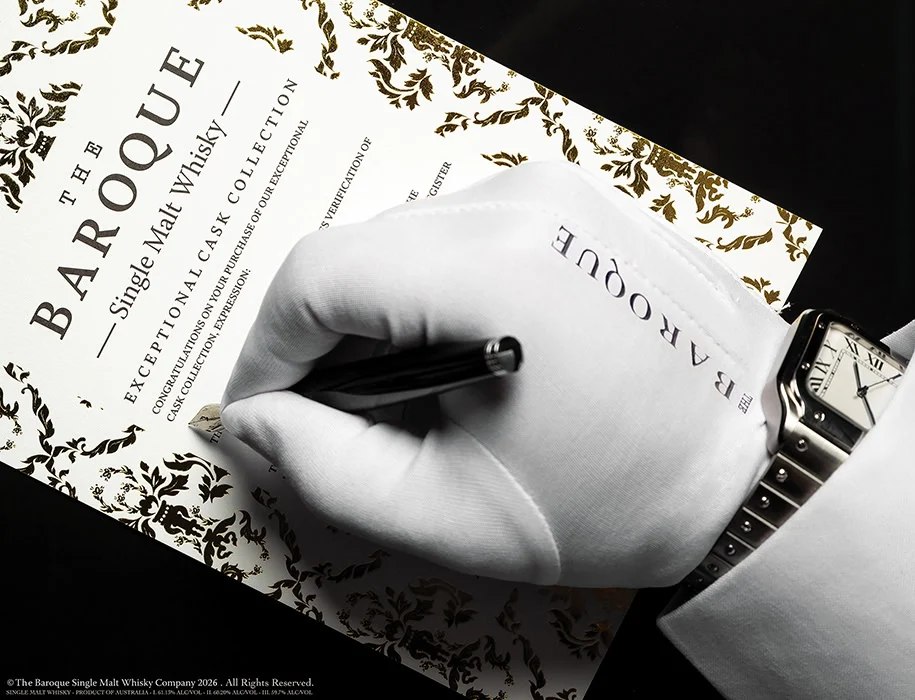
A white cotton glove descends softly upon a dark mahogany table. Beside it rests a sleek black fountain pen and an immaculate sheet of gold damask paper waiting for a proper inscription. Before a single drop of the highly anticipated Exceptional Cask Collection MMXXV leaves the shores of Australia, a representative at Baroque Whisky meticulously logs a unique bottle number into a physical and digital house register. That number will remain legally and logistically answerable for the next twenty-five years.
In an industry where the vast majority of legendary distilleries build their foundational mythos around the physical copper still, the silent mountain spring, or the romanticizing of centuries-old Scottish mists, Baroque Whisky has chosen a radically different path. This modern Australian house begins its story not with distillation, but with absolute accountability. Once that foundational philosophy is understood, every subsequent decision made by the house—from wood sourcing to climate maturation and global distribution—falls into sharp, deliberate focus.
Main Facts: Redefining Luxury Through Engineering and Provenance
Baroque Whisky operates as the flagship design house of The Baroque Single Malt Whisky Company, a licensed Australian alcohol manufacturer. It is neither a traditional distillery nor a standard independent bottler. Instead, the house functions as a luxury design studio, mapping out each individual expression across its complete life cycle. Baroque collaborates closely with select partner distilleries and master cooperages to oversee grain selection, mashing, fermentation, and initial distillation. From there, the house takes absolute, uncompromised control of cask procurement, barrel maturation, and final bottling.
Embracing the role of Curators of Spirit, Cask and Time, the brand refuses to hide behind vague marketing myths. Instead, it proudly publishes its rigorous methodology. This process relies on a comprehensive six-stage whisky engineering framework:
- Grain Architecture & Mash Bill Design (measured via diastatic power and phenol levels).
- Wort Engineering (tracked through specific gravity and turbidity).
- Fermentation Design (monitored for precise ester concentration).
- Spirit Cut Architecture (verified via strict chemical analysis at the spirit safe).
- Cask Strategy (sourced meticulously by historic wine appellation rather than generic wood categories).
- Expression Architecture (final blending or single-cask selection, entirely un-chill-filtered, presented at natural color, and—in the ultra-premium tier—offered at natural cask strength).
"Casks are sourced by appellation rather than by category, because a sherry butt from Jerez, a Cognac barrel from the Charente, and a Port pipe from the Douro each leave a different set of wine residues in the wood, and those residues are the raw material of the finished expression," explains J.E. Roberts, Director of Global Sales, Strategy, and Marketing. "We believe appellation should be a fact, and a strategy."
This perspective cuts sharply against industry norms. While mass-market spirits trade oak types and spin romantic stories about accidental discoveries, Baroque acquires specific European and American wood based on its historical provenance. The arithmetic is simple and unforgiving: one cask yields precisely what one cask yields, with zero room for artificial consistency.
Chronology: From Concept to the MMXXV Release
The creation of the MMXXV Collection follows a multi-year timeline of meticulous tracking, continuous evaluation, and global validation.
- Years Prior to Release: The engineering framework is initiated. Selected cooperages in Spain, France, Hungary, and America craft bespoke casks explicitly tailored to predetermined distillate profiles.
- Maturation & Continuous Monitoring: Unlike traditional cool-climate operations that rely on rigid calendar dates to dictate a whisky’s readiness, Baroque’s warm-climate maturation requires hyper-vigilant supervision. Because intense ambient temperature swings cause the spirit to expand deep into the oak and retract rapidly, the window of peak maturity can open and close within a single season. Casks are constantly sampled, measured, and tasted.
- August 10–11, 2026: Renowned critic F. Paul Pacult conducts an exhaustive, formal evaluation of the three flagship expressions at the Spirit Journal offices in Wallkill, New York. Evaluated from Spanish copitas—neat on day one and at a 20 percent dilution on day two—the spirits receive historic scores.
- October 2026: The Exceptional Cask Collection MMXXV makes its official international debut. Priced at AUD $4,200 per bottle, allocations are distributed across nine global currencies to private cellars from Monaco to Singapore, limited strictly to 180 total bottles worldwide (60 bottles per edition).
Supporting Data: The Cask Library and Critical Acclaim
The romance of single-cask whisky usually leans on serendipity—a forgotten barrel discovered decades later by sheer luck. Baroque works in reverse, treating the cask as a finely tuned instrument and the spirit as a custom composition written specifically for it.
"We spend more time finding oak than most houses spend making whisky," notes Roberts. "A rare American, French, Hungarian, or Spanish oak cask, with genuine provenance, becomes the entire design of an expression. We build the whisky around the cask, never the other way around."
The house’s extensive cask library features species that dictate explicit chemical properties:

- American Oak: Imparts classic vanillin depth and creamy coconut lactones.
- French Oak: Contributes robust structural tannins and fine, complex baking spices.
- Spanish Oak: Delivers profound dried fruit richness and deep natural color.
The MMXXV Trilogy Breakdown
Only the top three casks produced by the house in a given year are elevated to the Exceptional Cask Collection, ensuring absolute exclusivity without commercial blending:
- Edition I: Sourced from a rare ex-Tennessee Whiskey American oak cask bottled at a formidable 61.13% ABV. It features rich vanillin depth, a charcoal-mellowed character, caramelized banana notes, and warm baking spices across an intensely textured palate. (Rated 4 Stars / Highly Recommended by F. Paul Pacult).
- Edition II: Drawn from an antique Tawny Port barrel featuring interleaved French and American oak that spent decades housing fortified wine. It yields complex aromas of dried figs, rich walnut oils, dark chocolate, and aged cigar box. (Rated 4 Stars / Highly Recommended by F. Paul Pacult).
- Edition III: Derived from an ex-Meunier primary fermentation French oak cask bottled at 59.7% ABV. It stands as the trilogy’s brightest voice, offering vibrant orchard fruit, crisp red apple skin, poached pear, and delicate citrus blossom over a persistent, viscous mouthfeel. (Rated 5 Stars / Highest Recommendation by F. Paul Pacult).
Critical Validation
F. Paul Pacult’s evaluation of Edition III placed the Australian single malt into rarefied air, granting it five stars and comparing its structural brilliance to legendary American icons like Pappy Van Winkle’s Family Reserve 23 Year Old and Buffalo Trace’s George T. Stagg. Pacult praised the Meunier cask for its "integration and laser beam-like concentration, without ever being heavy handed," noting within ten minutes of tasting that it was destined to be an extraordinary release.
Official Responses and Operational Philosophy
The unique challenges of Australian distillation are met not with frustration, but with strategic acceptance of the climate’s intense nature.
"Our climate is impatient," says J.E. Roberts. "The whisky is driven deeper into the oak and drawn back out with every swing of temperature, and you can taste that concentration. We are not making Scotch faster. We are making something Australian."
This accelerated interaction creates significant evaporation losses—far exceeding the gentle angel’s share found in traditional Scottish warehouses. Every surviving bottle represents spirit that the intense Australian heat could not claim, cementing its status as a triumph of rarity over yield optimization.
To protect this exclusivity, Baroque has instituted a fiercely selective distribution model: one partner bar for the Premium Range, one partner private club for the Ultra-Premium range, and one exclusive partner retailer per country. Rather than chasing sales volume, the brand imposes an artificial ceiling on availability.
Implications: The Future of Ultra-Premium Australian Whisky
The introduction of the MMXXV Exceptional Cask Collection signals a profound shift in the global luxury spirits landscape. For decades, collectors looking for ultra-rare, high-investment single malts focused almost exclusively on Scotland and, more recently, Japan. Baroque Whisky is aggressively carving out a third pillar: ultra-premium Australian single malt.
Furthermore, the brand’s 25-Year Register directly addresses the growing anxiety surrounding authentication and secondary market fraud. By pairing encrypted Certificates of Authenticity with a quarter-century record-keeping commitment, Baroque ensures that if an auction house or collector attempts to verify a bottle in the year 2051, the house ledger will respond immediately.
With only 180 total bottles produced for the MMXXV release—each priced at AUD $4,200—access is exceptionally restricted. Private clients and collectors seeking to secure an allocation can register directly through official channels, while those in Australia can experience pours by appointment at Lounge de Versailles, an exclusive members-only rooftop cigar lounge in Melbourne’s CBD.
When the last of the 180 bottles finds a home in private cellars from Zurich to Singapore, the ledger will close, the fountain pen will be capped, and the world will be left waiting to see what Baroque engineers next.