Introduction: The Battle Over Nutritional Credibility
In the modern landscape of public health, few debates are as contentious—or as heavily influenced by corporate interests—as the validity of nutritional science. Critics from industry-backed think tanks frequently target observational studies, dismissing them as unreliable or low-quality. This skepticism is often weaponized against dietary guidelines that advise the public to consume less sugar, reduce processed foods, or cut back on red meat.
However, a closer examination reveals that this critique relies on a fundamental misapplication of research standards. By holding nutritional epidemiology to the rigid framework traditionally reserved for pharmaceutical drug trials, corporate-funded researchers have managed to manufacture doubt around public health recommendations. Understanding the nuances of study design, the realities of dietary research, and the history of corporate interference exposes these criticisms for what they truly are: a strategic playbook designed to protect profits at the expense of public well-being.
Main Facts: Observational Studies vs. Randomized Controlled Trials
To understand the corporate critique of nutritional science, one must first understand the structural differences between studying pharmaceuticals and studying diet.
Randomized controlled trials (RCTs) are the gold standard for evaluating medical interventions, such as prescription drugs. In an RCT, researchers can administer an active drug to one group and a placebo to another, ensuring double-blind conditions where neither the participants nor the researchers know who is receiving the treatment.
When it comes to nutrition, however, this gold standard is largely unattainable:
- The Placebo Problem: Humans cannot eat placebo food.
- Long Latency Periods: Diet-related chronic illnesses, such as cardiovascular disease and cancer, take decades to develop.
- Compliance Challenges: It is virtually impossible to force large cohorts of people to adhere to strict, assigned diets for the years required to observe hard clinical endpoints like heart attacks or mortality.
Because of these logistical barriers, nutritional scientists rely on observational studies—tracking large populations over extended periods to identify correlations between dietary patterns and health outcomes.
Critics often claim that observational data is inherently flawed. Yet, when researchers compare data from large-scale observational studies with randomized trials, the results are remarkably consistent. In approximately 90% of the treatments examined, the effects observed in population studies matched both the direction and the general magnitude of those found in RCTs.
Apparent discrepancies, such as the famous debate surrounding hormone replacement therapy (HRT) and heart disease risk, typically boil down to timing—specifically, when an intervention is initiated—rather than an inherent failure of observational methods. When timeline variables are properly accounted for, the studies ultimately tell the same story.
Chronology: A History of Corporate Interference in Dietary Guidelines
The systematic effort to undermine public health guidelines using flawed methodological critiques is not a recent phenomenon. It follows a well-documented historical chronology.
The Sugar Industry Playbook
Decades ago, public health committees began recognizing the severe health risks associated with excessive sugar consumption. As dietary guidelines increasingly recommended cutting back on added sugars, corporate entities pushed back.
A prominent milestone in this strategy was the publication of an industry-funded paper in Annals of Internal Medicine. This paper concluded that dietary guidelines advising people to reduce sugar intake were untrustworthy because they were based on "low-quality evidence."
To bolster their argument, the authors pointed to inconsistencies across various sugar guidelines over a 20-year period, arguing that shifting recommendations proved the science was unstable. However, a closer historical look reveals manufactured hypocrisy: the most glaring outlier during that timeline was a 2002 Institute of Medicine guideline—partially funded by corporate giants including Coca-Cola, PepsiCo, and major confectionery companies—which claimed that a quarter of the human diet could consist of straight sugar without causing nutritional deficiencies. Having helped create the very inconsistencies they pointed to, the industry then used those inconsistencies to argue that guidelines could not be trusted.
The Meat Industry Follows Suit
Following the playbook established by Big Sugar, meat industry-funded institutions adopted identical tactics. Recognizing that nutritional guidelines recommending lower red and processed meat consumption rely heavily on observational data (since lifelong RCTs forcing people to eat specific quantities of meat are unfeasible), industry groups hired the exact same methodologists who designed the sugar studies.
Predictably, these researchers applied the pharmaceutical-style GRADE framework to nutritional data, predictably concluding that the evidence linking red meat to colorectal cancer was "of low quality." This cleared the way for widespread media campaigns arguing that consumers could safely ignore public health advisories regarding meat consumption.
Supporting Data: Why the Drug Trial Paradigm Fails Nutrition
The core flaw in corporate critiques of nutrition science lies in what experts call "the inappropriate use of the drug trial paradigm in nutrition research."

The GRADE Framework vs. Nutrition-Specific Tools
The GRADE (Grading of Recommendations Assessment, Development, and Evaluation) system is designed primarily to evaluate pharmaceutical interventions. When applied rigidly to lifestyle and dietary interventions, GRADE almost always downgrades observational data, labeling it "low quality" simply because it is not derived from a double-blind, placebo-controlled trial.
However, researchers have developed alternative scoring systems specifically tailored to the realities of nutritional science:
- NutriGrade: A scoring system specifically designed to assess evidence in nutrition research. Crucially, NutriGrade accounts for funding bias, automatically downgrading trials that receive corporate industry funding. It is little wonder that industry-funded authors avoid NutriGrade in favor of pharmaceutical grading tools.
- HEALM (Hierarchies of Evidence Applied to Lifestyle Medicine): Created specifically because traditional tools like GRADE are inadequate for addressing lifestyle questions that cannot be fully answered through randomized trials.
The Trans Fat Precedent
The danger of demanding pharmaceutical-level certainty in public health is illustrated by the history of trans fats.
Researchers never conducted randomized controlled trials tracking hard endpoints like heart attacks and death by assigning participants to eat large quantities of industrial trans fats (such as canisters of shortening) every day for decades. Such an experiment would be profoundly unethical.
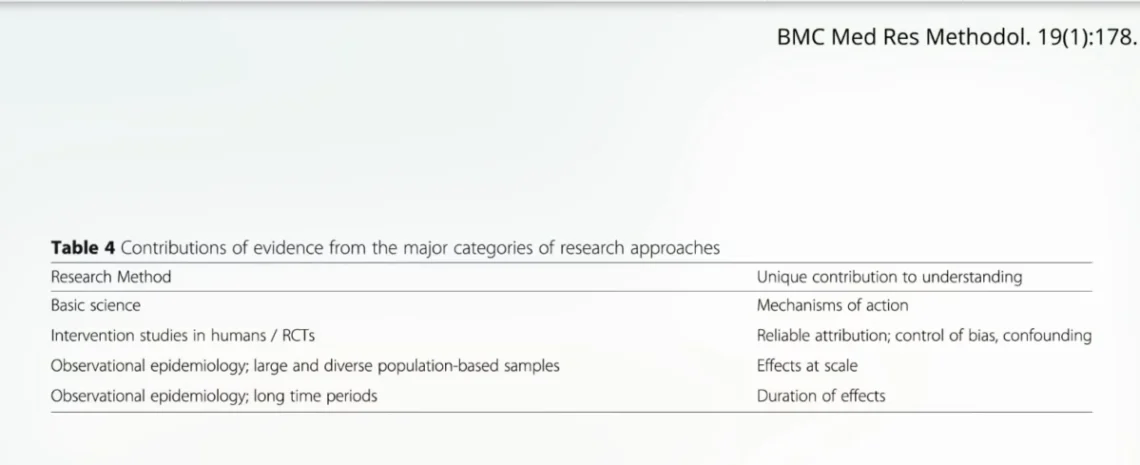
Instead, public health officials relied on a mosaic of evidence: laboratory studies exploring biochemical mechanisms, short-term RCTs showing that trans fats raised biomarkers for heart disease, and massive population studies linking higher trans fat intake to increased cardiovascular mortality.
Acting on this balance of evidence, regulatory bodies largely removed artificial trans fats from the food supply, ultimately preventing an estimated 200,000 heart attacks annually in the United States. If regulators had waited for pharmaceutical-grade RCTs before taking action, hundreds of thousands of lives would have been lost to corporate-style paralysis by analysis.
Official Responses and Comparative Risks: Drugs vs. Donuts
A fundamental tenet of risk management is that the required certainty of evidence must scale with the severity of potential harm. Yet, corporate critics invert this logic when evaluating lifestyle versus medicine.
The Hidden Toll of Prescription Drugs
Consider the relative safety profiles of medical interventions versus dietary advice:
- Prescription drugs are currently the third leading cause of death in the United States and Europe, trailing only heart disease and cancer.
- Approximately 100,000 Americans die annually from the side effects of prescription drugs—even when those medications are taken exactly as directed.
Because prescription drugs carry massive, life-threatening risks, rigorous double-blind, placebo-controlled RCTs are non-negotiable. Society demands rock-solid proof that the benefits of a pharmaceutical drug outweigh its inherent hazards.
The Safety of Dietary Advice
Conversely, telling the public to eat more broccoli, reduce soda consumption, or cut back on donuts carries virtually no risk of fatal toxicity.
Just as public health officials establish tolerable upper limits for environmental toxins like lead or polychlorinated biphenyls (PCBs) without conducting unethical experiments on children, they must formulate dietary guidelines using the best available balance of evidence. Demanding that everyday dietary advice meet the same evidentiary threshold as high-risk chemotherapy drugs is not a defense of science; it is a tactic designed to paralyze public health advocacy.
Implications for the Future of Public Health
The ongoing campaign by corporate lobbies to discredit observational nutrition science has profound implications for global health. Non-communicable diseases—including type 2 diabetes, cardiovascular disease, and various forms of cancer—remain leading drivers of morbidity and mortality worldwide. Nutritional factors are primary modifiable contributors to these conditions.
When food and beverage industries successfully reframe established nutritional science as "low-quality" or "unreliable," they erode public trust in health institutions. This manufactured skepticism creates a permissive environment for continued consumption of ultra-processed foods, added sugars, and harmful fats.
To safeguard public health against corporate capture, the scientific community, medical journals, and regulatory bodies must:
- Adopt Context-Appropriate Evaluation Tools: Promote the widespread use of nutrition-specific assessment frameworks like NutriGrade and HEALM over rigid pharmaceutical paradigms like GRADE.
- Disclose and Weight Funding Sources: Aggressively account for financial conflicts of interest in scientific literature, ensuring that industry-funded studies do not disproportionately dictate public policy.
- Prioritize Precautionary Action: Recognize that waiting for absolute, pharmaceutical-grade certainty in dietary research is an active choice—one that prioritizes corporate balance sheets over human lives.
Ultimately, public health officials must continue to act on the totality of evidence, balancing mechanistic lab research, clinical trials, and large-scale observational studies. In the battle between public well-being and corporate profits, society cannot afford to let the perfect become the enemy of the good.